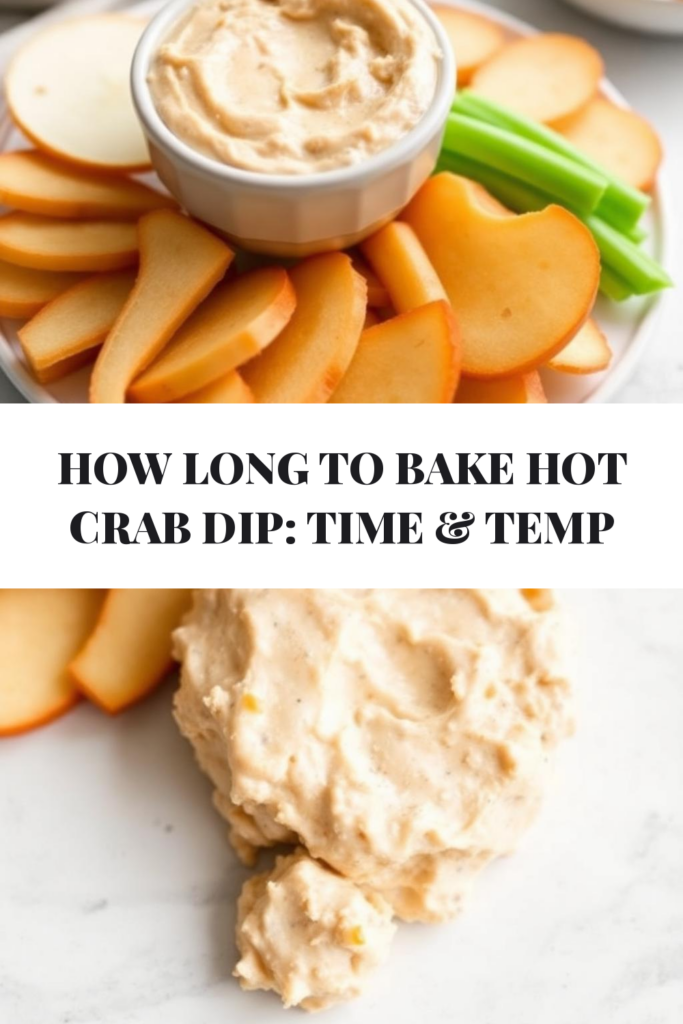
Bake hot crab dip at 375°F (190°C) for 20–25 minutes, until it is bubbling around the edges and lightly golden on top. This temperature and time let the dip heat through evenly without curdling the cream cheese or drying out the crab. The dip is done when a thermometer inserted in the center reads 160°F (71°C), the safe minimum for egg dishes and casseroles.
Why 375°F Works for Crab Dip
Hot crab dip is a mixture of cream cheese, mayonnaise, sour cream, seasonings, and lump crabmeat. Baking at 375°F (190°C) is hot enough to melt and blend the dairy quickly, but not so hot that the mayonnaise separates or the crab turns rubbery. At 350°F (177°C) the dip takes about 5 minutes longer and stays softer; at 400°F (204°C) it browns faster but can curdle if left in too long.
The standard baking vessel is an 8×8-inch (20×20-cm) baking dish or a 9-inch (23-cm) pie plate. A shallower dish, like a 9×13-inch (23×33-cm), will bake in 15–18 minutes because the dip spreads thinner. A deep casserole dish may need 30–35 minutes. Always check the center with a food thermometer, not just the edges.
Step-by-Step: From Mixing Bowl to Oven
- Preheat the oven to 375°F (190°C). Lightly grease an 8×8-inch (20×20-cm) baking dish.
- In a medium bowl, beat 8 oz (225 g) softened cream cheese, 1/2 cup (120 ml) mayonnaise, and 1/2 cup (120 ml) sour cream until smooth.
- Stir in 1 cup (100 g) shredded sharp cheddar, 1/4 cup (25 g) grated Parmesan, 1 teaspoon Worcestershire sauce, 1/2 teaspoon garlic powder, 1/4 teaspoon cayenne (optional), and a pinch of salt.
- Gently fold in 1 lb (450 g) lump crabmeat, picking through it first for shell fragments. Do not overmix; you want chunks of crab, not a paste.
- Spread the mixture into the prepared dish. Top with another 1/2 cup (50 g) shredded cheddar if you like a browned crust.
- Bake for 20–25 minutes, until the edges bubble and the top is golden in spots. The center should read 160°F (71°C) on an instant-read thermometer.
- Let rest for 5 minutes before serving. The dip will be very hot and will firm up slightly as it cools.
For a worked example: a 2-pound (900-g) batch in an 8×8-inch dish, starting from cold ingredients, took 23 minutes in a standard oven. The same batch in a 9×13-inch dish took 17 minutes. The thicker the layer, the longer the bake—so measure the dish, not the clock.
Where People Go Wrong: Curdled Dip and Dry Crab
The most common mistake is overbaking. Mayonnaise and sour cream break when heated past 180°F (82°C) for long, leaving a greasy, curdled texture. Pull the dip out as soon as it bubbles at the edges and the center hits 160°F (71°C). If the top is browning too fast, cover loosely with foil for the last 5 minutes.
Another error is adding the crab too early or stirring it too hard. Lump crab is already cooked; it only needs to warm through. Overmixing breaks the lumps into shreds, and baking longer than needed dries them out. Fold the crab in last, and stop as soon as it is distributed.
A third issue is using pre-shredded cheese. It contains anti-caking starch that can make the dip grainy. Shredding cheddar from a block gives a smoother melt. If you use pre-shredded, the dip still works but the texture is slightly less creamy.
How to Tell When Hot Crab Dip Is Done
Use three cues together: visual, textural, and temperature. The edges should be actively bubbling, not just warm. The top should have light brown spots, not a dark crust. The center, when probed with a thermometer, must read 160°F (71°C). That temperature is the USDA FSIS safe minimum for egg dishes and casseroles containing eggs.
If you do not have a thermometer, insert a clean knife into the center and hold for 5 seconds. The knife should come out hot to the touch, and the dip should not jiggle like liquid. A dip that still jiggles in the middle needs 5–7 more minutes. Remember that the dip continues to cook from residual heat after you pull it out, so do not wait for the entire surface to brown.
Make-Ahead, Reheating, and Storage
You can assemble the dip a day ahead. Mix everything, spread it in the dish, cover, and refrigerate for up to 24 hours. Add 5–7 minutes to the bake time because the dip starts cold. Check the center temperature before serving.
Leftover baked crab dip keeps in the refrigerator for 3–4 days in an airtight container. Reheat individual portions in the microwave at 50% power in 30-second bursts, or reheat the whole dish in a 350°F (177°C) oven for 10–15 minutes, until the center reaches 165°F (74°C) for leftovers. Do not leave the dip at room temperature for more than 2 hours (1 hour if the room is above 90°F/32°C).
Freezing is possible but changes the texture: the dairy can separate and the crab can become watery. If you freeze, do it before baking, wrap tightly, and use within 2 months. Thaw overnight in the refrigerator, then bake as directed, adding 5–10 minutes. Expect a slightly softer, less creamy dip after freezing.
Adjusting for Different Quantities and Dishes
For a smaller batch (8 oz/225 g crab), use a 6-inch (15-cm) ramekin or small skillet and bake for 15–18 minutes. For a larger party batch (2 lb/900 g crab), use a 9×13-inch (23×33-cm) dish and bake for 25–30 minutes. The rule is: the dip is done when the center reaches 160°F (71°C), regardless of the dish size.
If you bake in a cast-iron skillet, the dip will brown faster on the bottom and edges; check it 5 minutes early. If you use a glass dish, reduce the oven temperature to 350°F (177°C) and add 5 minutes, because glass conducts heat differently and can scorch the edges at 375°F.
For a broiler finish, bake at 375°F (190°C) for 18–20 minutes, then switch to broil for 1–2 minutes to brown the top. Watch it constantly—broilers vary wildly, and the dip can burn in seconds.
Related
- How Long Does Pasta Salad Last in the Freezer?
- How Long Does Egg Salad Last in the Freezer?
- Chili Dog Casserole with Cheese Dip Center Recipe
Safe minimum internal temperatures follow USDA FSIS; raw-fish guidance follows the U.S. FDA. See our food safety notes.
Spotted an error? Tell us and we will correct it (corrections policy).