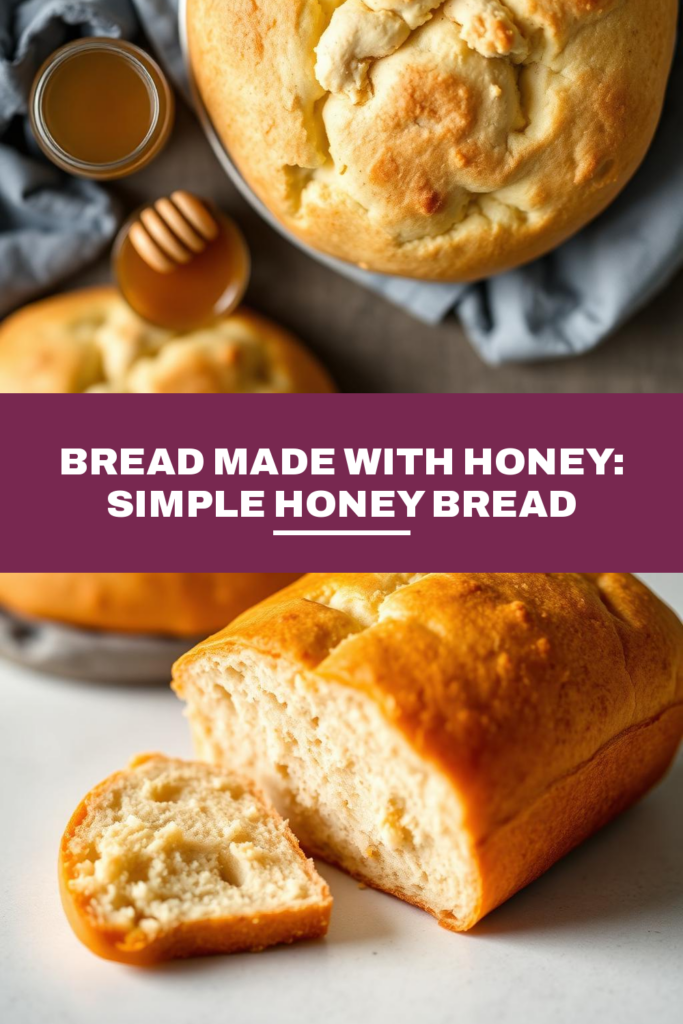
Time: 3 hr 20 min · Serves: 1 loaf (about 12 slices) · The key step: Use a kitchen thermometer to check the dough’s temperature after kneading (75–80°F / 24–27°C) and the loaf’s internal temperature when done (190–200°F / 88–93°C). This is a soft, lightly sweet sandwich loaf made with honey instead of sugar. It suits breakfast toast, lunchbox sandwiches, or a simple side for soup.
Ingredients for a 9×5-Inch Loaf
- 1 cup (240 ml) warm water (105–115°F / 40–46°C)
- 1/4 cup (85 g) honey
- 2 1/4 tsp (7 g) active dry yeast (one packet)
- 3 cups (375 g) all-purpose flour, plus more for dusting
- 1 1/2 tsp (9 g) salt
- 2 tbsp (28 g) unsalted butter, melted and cooled slightly
- 1 large egg, at room temperature (for egg wash, optional)
Instructions: Mix, Knead, Rise, Shape, Bake
- Proof the yeast: In a large bowl, stir the warm water and honey together. Sprinkle the yeast over the top and let stand for 5–10 minutes until foamy. If it does not foam, the yeast is dead or the water was too hot; start over with new yeast.
- Mix the dough: Add 2 cups (250 g) of the flour, the salt, and the melted butter. Stir with a wooden spoon until a shaggy dough forms. Add the remaining 1 cup (125 g) flour, 1/4 cup (30 g) at a time, until the dough pulls away from the sides of the bowl.
- Knead: Turn the dough onto a lightly floured surface. Knead for 8–10 minutes, until smooth and elastic. The dough should be tacky but not sticky; add flour only 1 tablespoon at a time if needed. If using a stand mixer with a dough hook, knead on medium-low for 6–8 minutes.
- First rise: Place the dough in a lightly oiled bowl, turning to coat. Cover with plastic wrap or a damp towel. Let rise in a warm (75–80°F / 24–27°C) spot for 1 to 1 1/2 hours, until doubled in size. To check: press two fingers into the dough; the indent should stay.
- Shape: Punch down the dough. On a lightly floured surface, flatten into a rectangle about 8×12 inches (20×30 cm). Roll tightly from the short end, pinching the seam. Place seam-side down in a greased 9×5-inch (23×13 cm) loaf pan.
- Second rise: Cover the pan loosely with plastic wrap. Let rise for 45–60 minutes, until the dough rises about 1 inch (2.5 cm) above the rim of the pan.
- Preheat and egg wash: About 20 minutes before baking, preheat the oven to 375°F (190°C). If using the egg wash, whisk the egg with 1 tablespoon (15 ml) water and brush gently over the top.
- Bake: Bake for 30–35 minutes, until the top is deep golden brown and the internal temperature reads 190–200°F (88–93°C) on an instant-read thermometer. If the top browns too quickly, tent loosely with foil after 20 minutes.
- Cool: Remove from the pan immediately and transfer to a wire rack. Cool completely, at least 2 hours, before slicing. Slicing warm bread compresses the crumb and makes it gummy.
Half and Double Batch Scaling
This recipe scales by simple multiplication. Use the same proofing and baking times; a half loaf bakes in a 8×4-inch (20×10 cm) pan for 25–30 minutes, a double loaf in two 9×5-inch pans for 35–40 minutes.
| Batch | Flour | Water | Honey | Yeast | Salt | Butter | Pan |
|---|---|---|---|---|---|---|---|
| Half | 1 1/2 cups (188 g) | 1/2 cup (120 ml) | 2 tbsp (42 g) | 1 1/8 tsp (3.5 g) | 3/4 tsp (4.5 g) | 1 tbsp (14 g) | 8×4 in (20×10 cm) |
| Full | 3 cups (375 g) | 1 cup (240 ml) | 1/4 cup (85 g) | 2 1/4 tsp (7 g) | 1 1/2 tsp (9 g) | 2 tbsp (28 g) | 9×5 in (23×13 cm) |
| Double | 6 cups (750 g) | 2 cups (480 ml) | 1/2 cup (170 g) | 4 1/2 tsp (14 g) | 1 tbsp (18 g) | 4 tbsp (56 g) | two 9×5 in (23×13 cm) |
Why the Loaf Turns Out Too Dry, Too Dense, or Too Runny
Too dry: Overbaking is the usual cause. Honey browns faster than sugar, so the crust may look done before the center is. Use the thermometer, not the color. Also, too much flour during kneading makes a dry crumb; add only 1 tablespoon at a time.
Too dense: The dough did not rise enough. Check that the yeast is fresh and the water is between 105–115°F (40–46°C). Too-hot water kills yeast; too-cool slows it. Also, under-kneading leaves the gluten weak, so the loaf cannot hold its rise. Knead until the dough passes the windowpane test: stretch a small piece thin enough to see light through without tearing.
Too runny (or gummy center): This is usually underbaking. A gummy center means the loaf was removed before the internal temperature reached 190°F (88°C). It can also happen if the dough was too wet; resist adding all the flour if the dough is already smooth. If the center sinks after cooling, the loaf was underbaked or the second rise was too long, causing the structure to collapse.
Storing Honey Bread and Freezing
Cool the loaf completely before storing. Wrap tightly in plastic wrap or keep in a bread box at room temperature for up to 3 days. Honey helps retain moisture, so it may stay soft longer than plain bread. For longer storage, slice the loaf and freeze in a zip-top bag for up to 3 months. Thaw slices at room temperature or toast directly from frozen. Do not refrigerate bread; it goes stale faster in the fridge.
Swapping Honey for Sugar or Other Sweeteners
Honey is about 20% sweeter than granulated sugar by volume, so if you replace honey with sugar, use 3/4 cup (150 g) sugar for the same sweetness, but you will need to add about 1/4 cup (60 ml) extra water to keep the dough hydration. If you use maple syrup instead of honey, use the same amount and expect a slightly thinner dough; add flour 1 tablespoon at a time if needed. For a less sweet loaf, reduce honey to 3 tablespoons (63 g) and add 1 tablespoon (15 ml) water to keep the liquid ratio.
Using a Bread Machine or Stand Mixer
For a bread machine, add the water, honey, butter, salt, and flour in the order your machine recommends, then make a well and add the yeast. Use the basic white bread cycle, medium crust. Check the dough after 5 minutes of kneading; it should form a smooth ball. For a stand mixer, use the dough hook on medium-low for 6–8 minutes, then follow the rising and baking steps above. Note that machine times vary by model, so rely on the dough’s appearance and the final internal temperature.
Related
- Honey Cider Vinaigrette Recipe
- Apple Cider Honey Vinaigrette Recipe
- Paleo Fruit Dip (Coconut Cream & Honey)
Safe minimum internal temperatures follow USDA FSIS; raw-fish guidance follows the U.S. FDA. See our food safety notes.
Spotted an error? Tell us and we will correct it (corrections policy).