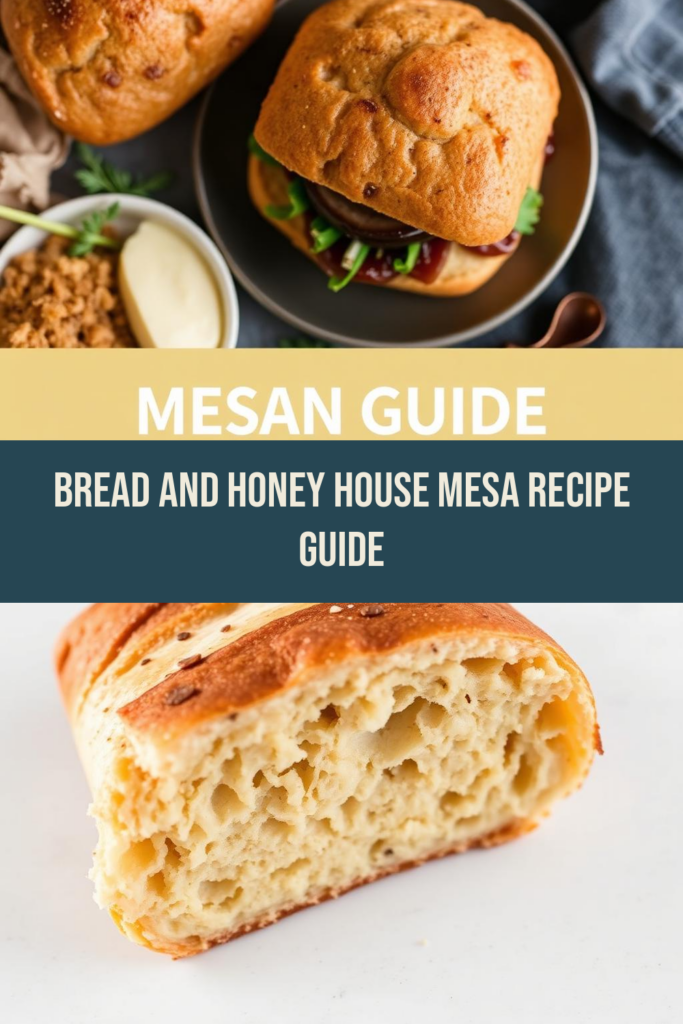
Bread and honey house mesa is a simple sweet bread that gets its texture from a thick honey glaze poured over the top before baking. The glaze sinks into the batter as it bakes, creating a dense, moist crumb with a sticky, caramelized top. It suits a weekday breakfast, an afternoon snack, or a potluck dessert plate.
Ingredients
- 2 cups (250 g) all-purpose flour
- 1 tsp baking powder
- 1/2 tsp baking soda
- 1/2 tsp salt
- 1/2 cup (115 g) unsalted butter, softened
- 1 cup (200 g) granulated sugar
- 2 large eggs, room temperature
- 1 tsp vanilla extract
- 1 cup (240 ml) buttermilk, room temperature
- 1/2 cup (170 g) honey
- 1/4 cup (60 ml) water
Instructions
- Heat the oven to 350°F (175°C). Grease a 9×5-inch (23×13 cm) loaf pan and line the bottom with parchment paper.
- In a medium bowl, whisk the flour, baking powder, baking soda, and salt.
- In a large bowl, beat the butter and sugar with an electric mixer on medium speed until light and fluffy, about 3 minutes. Add the eggs one at a time, beating well after each, then beat in the vanilla.
- With the mixer on low, add the flour mixture in three additions, alternating with the buttermilk in two additions, beginning and ending with flour. Mix just until no streaks of flour remain; do not overmix.
- Pour the batter into the prepared pan and smooth the top. Bake for 40–45 minutes, until a toothpick inserted in the center comes out with a few moist crumbs, not wet batter. The top will be deep golden brown.
- While the loaf bakes, make the honey glaze: in a small saucepan, combine the honey and water. Bring to a simmer over medium heat, stirring, then remove from heat. Let cool for 5 minutes.
- When the loaf is done, remove it from the oven and let it cool in the pan for 10 minutes. Poke the top all over with a skewer or fork, then slowly pour the warm honey glaze over the loaf, letting it soak in. Let the loaf cool completely in the pan, at least 1 hour, before slicing.
Why the Glaze Sinks Instead of Sitting on Top
The glaze works because the loaf is still warm when you pour it. Warm bread absorbs liquid; if you wait until the loaf is cool, the glaze will pool on top and form a hard candy layer. The poking step creates channels for the glaze to travel into the crumb. Pour the glaze in two or three batches, waiting a minute between each, so it has time to soak in rather than run off the sides.
Substitutions and What They Change
- Buttermilk: Use 1 cup (240 ml) whole milk mixed with 1 tbsp (15 ml) lemon juice or white vinegar, left to sit for 5 minutes. This swap makes the crumb slightly less tender because the acid level is lower.
- Honey: Use a mild honey like clover or orange blossom. Strong honey like buckwheat will make the bread taste darker and more floral. Do not replace honey with maple syrup; it is too thin and the glaze will not set.
- Butter: Use 1/2 cup (115 g) plain unsalted margarine or coconut oil (solid, not melted). Coconut oil makes the crumb slightly more dense and adds a faint coconut note.
- All-purpose flour: Use 1 cup (125 g) white whole wheat flour plus 1 cup (125 g) all-purpose flour. The bread will be denser and less sweet.
Why It Comes Out Dry, Runny, or Dense—and the Fix
Too Dry
If the loaf is dry, it was overbaked or the flour was measured too heavily. Check the loaf at 40 minutes; if a toothpick comes out clean, it is done even if the top is pale. For flour, spoon it into the measuring cup and level it off, rather than scooping. If you already baked a dry loaf, brush the top with warm honey mixed with an equal amount of water before serving.
Too Runny in the Center
A sunken, raw center means the batter was underbaked or the pan was too large, making the loaf too shallow. Always use a 9×5-inch (23×13 cm) pan. If the top browns too quickly while the center is still wet, cover the pan loosely with foil at the 30-minute mark. The loaf is done when the internal temperature reaches 200°F (93°C) on an instant-read thermometer.
Too Dense and Heavy
Overmixing the batter develops gluten, making the crumb tough and dense. Mix only until the flour disappears. Also, check that your baking powder is not expired; if it is older than 6 months, it may not leaven properly. Dense bread can also come from cold buttermilk; let it sit at room temperature for 20 minutes before mixing.
Storing and Keeping the Crust Sticky
Store the bread in an airtight container at room temperature for up to 3 days. The glaze will gradually soak into the crumb, making it more moist but less sticky on top. To keep the top sticky, store the loaf cut-side down on a plate, covered with a clean kitchen towel, but this will dry the cut edge faster. Refrigerate for up to 5 days, but cold bread will firm up; let slices come to room temperature or toast them. Freeze the whole loaf wrapped in plastic wrap and foil for up to 3 months; thaw at room temperature for 2 hours before slicing.
Can I Make This Ahead or Double the Recipe?
Yes, the loaf tastes best the day it is made, but it keeps well for 2 days. To make ahead, bake and glaze the loaf, cool completely, then wrap and store at room temperature. For a double batch, use two 9×5-inch (23×13 cm) pans and bake both on the same rack, rotating them halfway through; the baking time stays the same because the pans are not overcrowded. Do not pour the glaze over the loaf until just before serving if you plan to freeze it; freeze the unglazed loaf, then glaze after thawing.
Related
- Honey Cider Vinaigrette Recipe
- Apple Cider Honey Vinaigrette Recipe
- Ken’s Steak House Apple Cider Vinaigrette Recipe
Safe minimum internal temperatures follow USDA FSIS; raw-fish guidance follows the U.S. FDA. See our food safety notes.
Spotted an error? Tell us and we will correct it (corrections policy).