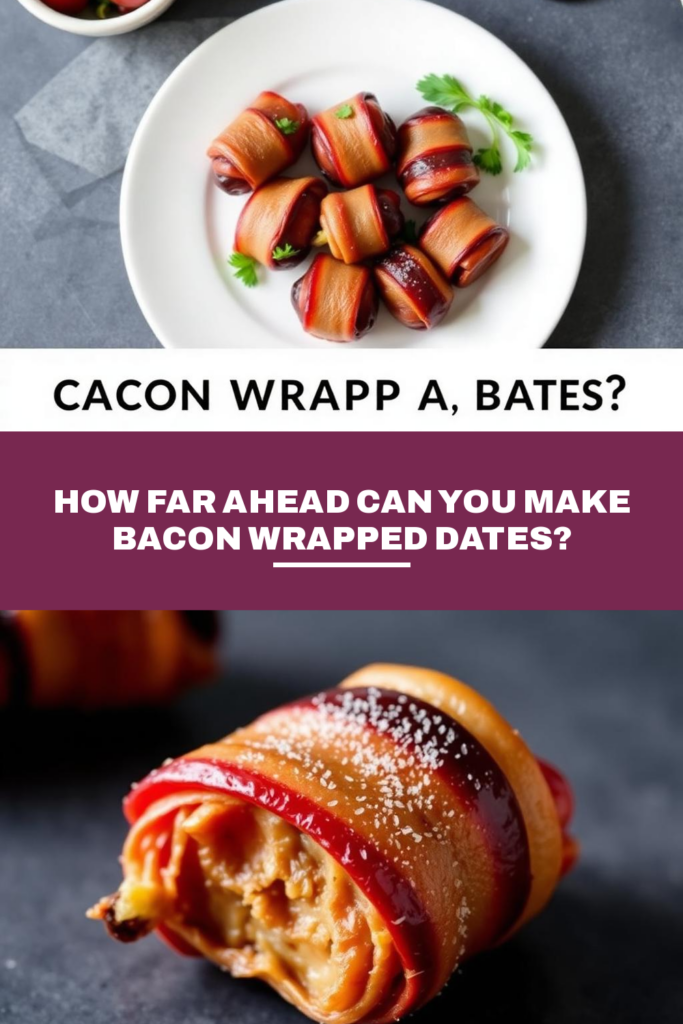
You can assemble bacon-wrapped dates up to 24 hours ahead and refrigerate them, as long as the dates are pitted and the bacon is fully wrapped around each one. The reason is that raw bacon and dates are both safe to hold cold for a day, and the bacon’s fat and the dates’ sugar keep the texture intact during that time. For longer make-ahead, freeze the assembled, unbaked dates for up to 3 months and bake them straight from the freezer.
24 Hours Ahead: Assemble, Refrigerate, Bake Later
Assembling the dates 12 to 24 hours before baking works well for holiday parties and dinner prep. Use a standard 12-ounce (340 g) package of thinly sliced bacon; each slice yields about 3 to 4 wrapped dates, so a pound of dates (about 24 dates) needs roughly 6 to 8 slices. Cut each bacon slice in half crosswise, wrap each date with one half, and secure with a toothpick.
Place the wrapped dates in a single layer on a plate or baking sheet, cover tightly with plastic wrap, and refrigerate. They will hold for up to 24 hours without the bacon turning slimy or the dates drying out. When ready to bake, preheat the oven to 400°F (200°C), line a rimmed baking sheet with foil, and place a wire rack on top. Arrange the dates on the rack so air circulates underneath, then bake for 18–22 minutes, until the bacon is browned and crisp and the dates are soft.
Check the bacon’s doneness by its color and texture, not by temperature, since bacon is cured and fully cooked when it reaches 145°F (63°C) but is usually crisped further. For a softer, less crisp result, bake 15–18 minutes. If you prefer a glaze (like honey or maple syrup), brush it on during the last 5 minutes of baking so it doesn’t burn.
Freeze for Up to 3 Months: Assemble, Freeze, Bake Frozen
For longer make-ahead, freeze the assembled, unbaked dates. After wrapping and securing each date with a toothpick, place them in a single layer on a baking sheet lined with parchment paper. Freeze for 1–2 hours, until solid, then transfer to a freezer-safe bag or container, pressing out as much air as possible. They will keep for up to 3 months without quality loss.
Bake frozen dates directly from the freezer—no thawing needed. Preheat the oven to 400°F (200°C), place the frozen dates on a wire rack over a foil-lined baking sheet, and bake for 22–26 minutes, until the bacon is browned and crisp. The extra time accounts for the frozen core. If you thaw them first, bake for 18–22 minutes as usual, but note that thawed dates may release more liquid and turn slightly softer.
Freezing changes the texture slightly: the dates become a bit more jammy and the bacon may render less fat, so the exterior is less shatter-crisp. For the crispiest result, bake frozen dates at 425°F (220°C) for 20–24 minutes, watching closely to avoid burning. Always use a food thermometer to confirm the bacon reaches at least 145°F (63°C) if you are checking for safety, though visual crispness is the usual cue.
What to Check Before You Assemble: Pits, Bacon Thickness, and Toothpicks
Pitted dates are essential. If you buy whole dates, cut a slit lengthwise and remove the pit, then press the date back together. If you stuff the dates with cheese (like goat cheese or blue cheese), the filling must be added at assembly time and the stuffed dates should be refrigerated for no more than 24 hours—cheese left out at room temperature for more than 2 hours is unsafe. For a 24-hour make-ahead, use a firm cheese that won’t weep, and keep the dates cold until baking.
Bacon thickness matters. Regular-cut bacon crisps better and wraps more easily than thick-cut, which takes longer to render and may stay chewy. If you only have thick-cut, slice it in half lengthwise to make thinner strips, and expect a slightly longer bake time (add 2–3 minutes). Turkey bacon is leaner and dries out faster; it works for make-ahead but will be less crisp and may stick to the rack—use a silicone mat or extra foil.
Toothpicks: use wooden toothpicks, and soak them in water for 10 minutes before assembling to prevent burning. If you skip toothpicks, the bacon may unroll during baking. For a toothpick-free version, wrap the bacon tightly and place the dates seam-side down on the rack, but they may still shift.
How to Reheat Leftovers Without Drying Them Out
Baked bacon-wrapped dates are best served within 30 minutes of coming out of the oven, but leftovers can be reheated. Store leftovers in an airtight container in the refrigerator for up to 3 days. To reheat, place them on a wire rack over a baking sheet and warm in a 350°F (175°C) oven for 8–10 minutes, until the bacon is hot and crisp again. Avoid the microwave, which makes the bacon rubbery and the dates mushy.
If you have a large batch, reheat only what you need, because repeated reheating dries out the dates. For a party, you can bake the dates 1 hour ahead and keep them warm in a 200°F (95°C) oven, covered loosely with foil for up to 1 hour—this keeps them warm without overcooking. After that, the bacon softens.
Signs Your Make-Ahead Dates Have Gone Wrong
Check for these signs before baking:
- Slimy bacon: If the bacon feels sticky or has a sour smell after 24 hours in the fridge, discard the batch. Fresh raw bacon should feel dry and smell mild.
- Discolored dates: Dates that turn dark or develop a fermented smell are past their prime; use fresh dates within their package date.
- Freezer burn: If frozen dates have gray or white patches on the bacon, they are still safe but will taste dry; trim the worst spots and bake as usual.
- Unraveled bacon: If the bacon has slipped off during storage, re-wrap and resecure with a fresh toothpick before baking.
Always keep raw bacon refrigerated at 40°F (4°C) or below, and never leave assembled dates at room temperature for more than 2 hours (1 hour if the room is above 90°F/32°C). If you are baking from frozen, do not thaw at room temperature—bake directly from the freezer.
Related
- Easy Friendsgiving Snack Mixes to Make Ahead
- Freezer Friendly Strawberry Recipes to Make Ahead
- Breakfast Pasta Dish: Eggs, Bacon, and Parmesan
Safe minimum internal temperatures follow USDA FSIS; raw-fish guidance follows the U.S. FDA. See our food safety notes.
Spotted an error? Tell us and we will correct it (corrections policy).