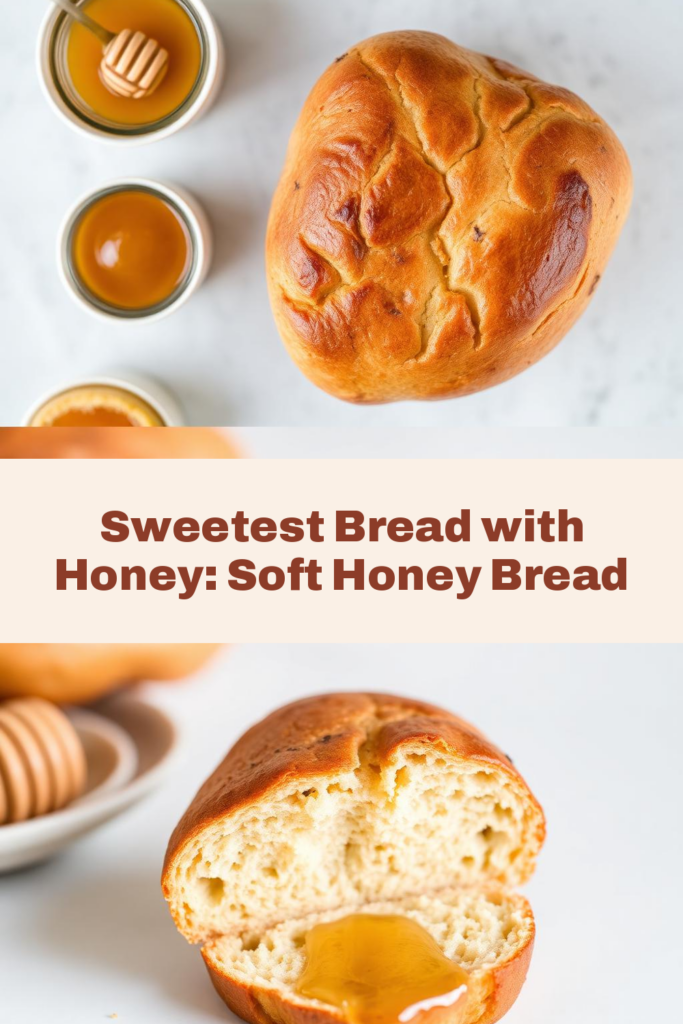
This honey bread is the sweetest you’ll make without added sugar, with a tender, moist crumb and a deep, floral aroma from the honey itself. The method uses a warm liquid and a long first rise to develop both sweetness and a soft, pull-apart texture that suits breakfast, tea, or dessert.
Ingredients
- 1 cup (240 ml) whole milk
- 1/2 cup (170 g) honey, divided
- 4 tbsp (57 g) unsalted butter, melted and cooled
- 1 large egg, room temperature
- 1 tsp (5 g) fine salt
- 4 cups (500 g) bread flour, plus more for dusting
- 2 1/4 tsp (7 g) active dry yeast (one packet)
- 1 tbsp (15 ml) water (for glaze)
Instructions
- Warm the milk: In a small saucepan, heat the milk to 110°F (43°C). Stir in 1/4 cup (85 g) of the honey and the melted butter. The mixture should feel warm, not hot.
- Proof the yeast: In a large bowl, combine the warm milk mixture and the yeast. Let stand for 5-10 minutes until foamy. If it does not foam, the yeast is dead; start over with fresh yeast.
- Mix the dough: Add the egg, salt, and 3 cups (375 g) of the flour. Stir with a wooden spoon until a shaggy dough forms. Turn out onto a floured surface and knead, adding the remaining 1 cup (125 g) flour as needed, for 8-10 minutes until smooth and elastic. The dough should be slightly tacky but not sticky.
- First rise: Place the dough in a lightly oiled bowl, cover with plastic wrap or a damp towel, and let rise in a warm spot (about 75°F/24°C) for 1 1/2 to 2 hours, until doubled in size.
- Shape: Punch down the dough. On a lightly floured surface, shape it into a loaf and place it in a greased 9×5-inch (23×13 cm) loaf pan. Cover loosely and let rise again for 45-60 minutes, until it rises about 1 inch (2.5 cm) above the rim.
- Bake: Preheat the oven to 350°F (175°C). Bake the loaf for 30-35 minutes, until the top is deep golden brown and the internal temperature reaches 190°F (88°C) on an instant-read thermometer. If the top browns too quickly, tent loosely with foil after 20 minutes.
- Glaze: In a small bowl, mix the remaining 1/4 cup (85 g) honey with 1 tbsp (15 ml) water. Brush this glaze over the hot loaf as soon as it comes out of the oven. Let cool in the pan for 10 minutes, then transfer to a wire rack.
How to Scale This Recipe for Half or Double Batches
Use this table for exact amounts when you need a smaller or larger loaf. The rise times stay the same; only the pan size changes.
| Batch | Flour | Milk | Honey | Butter | Egg | Yeast | Pan |
|---|---|---|---|---|---|---|---|
| Half | 2 cups (250 g) | 1/2 cup (120 ml) | 1/4 cup (85 g) | 2 tbsp (28 g) | 1 | 1 1/8 tsp (3.5 g) | 8×4-inch (20×10 cm) |
| Full | 4 cups (500 g) | 1 cup (240 ml) | 1/2 cup (170 g) | 4 tbsp (57 g) | 1 | 2 1/4 tsp (7 g) | 9×5-inch (23×13 cm) |
| Double | 8 cups (1 kg) | 2 cups (480 ml) | 1 cup (340 g) | 8 tbsp (113 g) | 2 | 1 1/2 tbsp (14 g) | Two 9×5-inch (23×13 cm) |
For a half batch, reduce the first rise to 1-1 1/4 hours and the second to 30-45 minutes. For a double batch, use two pans and bake for the same time; check doneness at 30 minutes.
How to Serve and Pair This Honey Bread
Serve slices warm or at room temperature. The honey flavor pairs well with salted butter, ricotta, or sliced pears. For breakfast, toast slices and spread with cream cheese. For dessert, drizzle with extra honey and sprinkle with flaky salt. It also makes excellent French toast: soak thick slices in a custard of 3 eggs, 1 cup (240 ml) milk, and 1 tsp vanilla, then cook on a griddle at 350°F (175°C) for 2-3 minutes per side.
How Long Does Honey Bread Keep?
Store the bread in an airtight container or wrapped in plastic wrap at room temperature for up to 4 days. The honey glaze helps keep it moist. For longer storage, wrap tightly and freeze for up to 3 months. Thaw at room temperature for 2 hours before serving. Do not refrigerate the bread; it will dry out faster. If the bread develops any mold, discard it immediately.
Why Does My Honey Bread Come Out Dry or Dense?
Dry bread usually means too much flour or overbaking. Measure flour by spooning it into the cup and leveling off, not scooping. Check the internal temperature at 30 minutes; it should read 190°F (88°C) but not exceed 200°F (93°C). Dense bread often comes from under-proofing: the first rise should double in volume, and the second rise should make the dough rise above the pan rim. If your kitchen is cool, place the dough in an oven with the light on (about 80°F/27°C) to speed the rise.
Can I Use a Different Sweetener or Flour?
Yes, but the texture changes. Replace honey with maple syrup or agave in equal volume, but reduce the milk by 2 tbsp (30 ml) because syrups are more liquid. For a less sweet loaf, reduce honey to 1/3 cup (113 g) and add 2 tbsp (25 g) sugar. For whole wheat, substitute up to half the bread flour with whole wheat flour; add 2 tbsp (30 ml) more milk and expect a denser crumb. Gluten-free flour blends will not work in this recipe without additional xanthan gum and a different hydration ratio; use a tested gluten-free bread recipe instead.
Honey Bread for Large Batches and Kids
For a crowd, make the double batch and slice into 24 pieces. For kids, cut the bread into small squares and serve with a honey-yogurt dip (mix 1/2 cup Greek yogurt with 1 tbsp honey). The bread is safe for children over 1 year old; do not give honey to infants under 1 year due to botulism risk. When making French toast with kids, use pasteurized eggs and heat the bread to 165°F (74°C) before serving.
Related
- Honey Cider Vinaigrette Recipe
- Apple Cider Honey Vinaigrette Recipe
- Paleo Fruit Dip (Coconut Cream & Honey)
Safe minimum internal temperatures follow USDA FSIS; raw-fish guidance follows the U.S. FDA. See our food safety notes.
Spotted an error? Tell us and we will correct it (corrections policy).