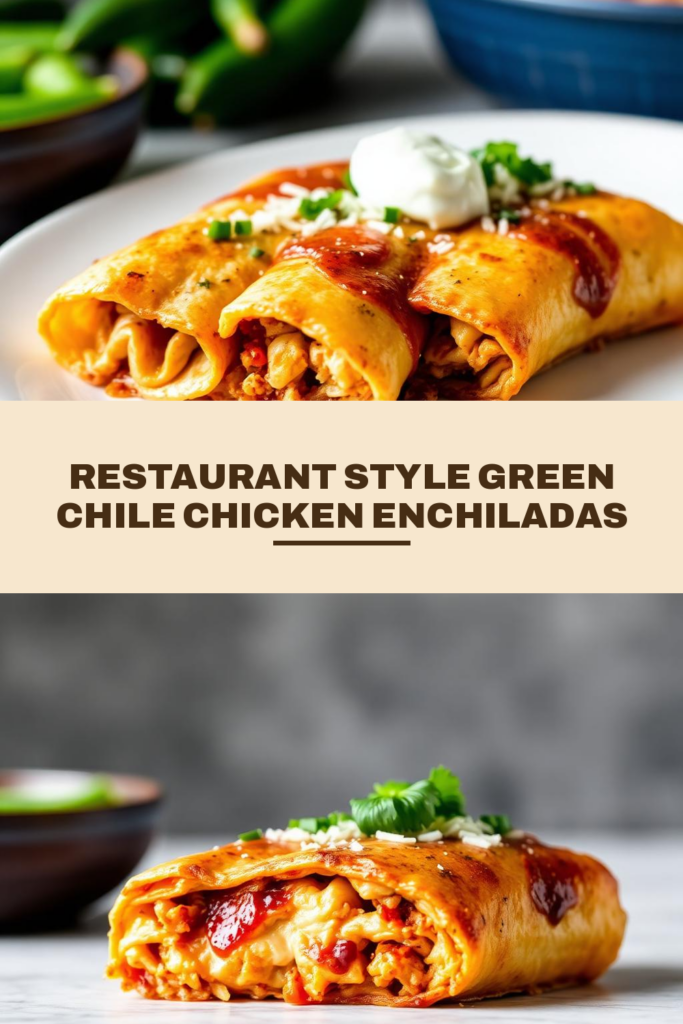
Restaurant-style green chile chicken enchiladas depend on a sauce that is thick enough to coat the tortillas without turning the dish soupy, and a filling that stays moist after baking. The key is a roux-thickened green chile sauce made with tomatillos or green chiles, plus a generous amount of cheese that melts into a cohesive layer. This version bakes at 375°F (190°C) for 20–25 minutes, until the sauce bubbles and the top cheese is golden and set.
Ingredients
For the green chile sauce:
- 2 tbsp (30 ml) vegetable oil
- 2 tbsp (16 g) all-purpose flour
- 1 cup (240 ml) chicken broth
- 1 cup (240 ml) milk (whole or 2%)
- 1 can (4 oz / 113 g) diced green chiles, undrained
- 1/2 cup (120 ml) sour cream
- 1/2 tsp salt
- 1/4 tsp black pepper
- 1/4 tsp ground cumin
For the filling:
- 3 cups (about 450 g) cooked, shredded chicken (from 2–3 chicken breasts or 1 rotisserie chicken)
- 1 cup (120 g) shredded Monterey Jack cheese
- 1/2 cup (60 g) shredded cheddar cheese
- 1/2 cup (120 g) sour cream
- 1/4 cup (25 g) chopped green onions (white and green parts)
- 1/2 tsp salt
- 1/2 tsp ground cumin
For assembly:
- 12 (6-inch / 15 cm) corn tortillas
- 1 cup (120 g) shredded Monterey Jack or cheddar cheese for topping
- Chopped cilantro and extra green onions for garnish (optional)
Instructions
- Preheat oven to 375°F (190°C). Lightly grease a 9×13-inch (23×33 cm) baking dish.
- Make the sauce: In a medium saucepan, heat oil over medium heat. Whisk in flour and cook for 1–2 minutes, until bubbly and lightly golden. Gradually whisk in chicken broth and milk. Cook, stirring constantly, until the mixture thickens and bubbles, about 5–7 minutes. It should coat the back of a spoon.
- Remove from heat and stir in diced green chiles, sour cream, salt, pepper, and cumin. Set aside.
- Make the filling: In a large bowl, combine shredded chicken, 1 cup Monterey Jack, 1/2 cup cheddar, 1/2 cup sour cream, green onions, salt, and cumin. Mix well.
- Warm the tortillas: Heat a dry skillet over medium heat. Warm each tortilla for about 15–20 seconds per side, until soft and pliable. Alternatively, stack tortillas between damp paper towels and microwave for 30–45 seconds.
- Assemble the enchiladas: Spread about 1/2 cup of the sauce on the bottom of the prepared dish. For each tortilla, place about 1/4 cup of filling in the center, roll up tightly, and place seam-side down in the dish. Repeat with remaining tortillas.
- Pour the remaining sauce over the enchiladas, spreading it evenly. Sprinkle the top with 1 cup shredded cheese.
- Bake for 20–25 minutes, until the sauce is bubbly and the cheese is melted and lightly golden. If you want a browner top, broil for 1–2 minutes at the end, watching closely.
- Let stand for 5 minutes before serving. Garnish with cilantro and green onions if desired.
Why the Sauce Can Turn Out Too Runny or Too Thick
The sauce is the most fragile part. If it is too runny, the enchiladas will be soggy and the dish will pool liquid. If it is too thick, the sauce won’t coat the tortillas evenly and the dish will be dry.
Too runny
This happens when the roux is not cooked long enough or the sauce is not simmered to thicken. Cook the flour-oil mixture for a full 1–2 minutes to remove the raw flour taste and allow the starch to expand. After adding the liquid, let it come to a gentle boil and cook for 5–7 minutes, stirring, until it visibly thickens. If it still seems thin, simmer for another 2–3 minutes.
Too thick
If the sauce is too thick, it will be pasty and hard to spread. This usually comes from too much flour or cooking too long. If this happens, whisk in extra chicken broth, 1 tablespoon at a time, until it reaches a pourable consistency.
Substitutions That Change the Result
- Flour: Use 2 tbsp (16 g) cornstarch mixed with 2 tbsp (30 ml) cold water as a slurry instead of the roux. Add it after the broth and milk come to a simmer. The sauce will be slightly glossier and less creamy.
- Milk: Use half-and-half or evaporated milk for a richer, thicker sauce. Use 1 cup (240 ml) of any of these. The sauce will be more decadent.
- Sour cream: Use plain Greek yogurt (full-fat) in the sauce or filling. It will be slightly tangier and a bit less rich. Add it off the heat to avoid curdling.
- Green chiles: For a spicier version, use 2 fresh roasted poblano peppers, peeled and diced, instead of the canned chiles. The flavor will be smokier and the heat more pronounced.
- Chicken: Use shredded pork or beef. The cooking time remains the same, but the filling will be richer and heavier.
- Tortillas: Use flour tortillas (6-inch / 15 cm) instead of corn. They will be softer and less likely to crack, but the texture will be more like a burrito.
Three Specific Mistakes and What They Cause
- Not warming the tortillas: Cold corn tortillas crack and tear when rolled, leaving gaps that leak filling and sauce. Warm them until pliable before assembling.
- Overfilling the tortillas: Too much filling makes the rolls bulge and split during baking. Use about 1/4 cup per tortilla; if you have extra filling, serve it on the side.
- Skipping the rest time: Cutting into the enchiladas immediately makes them fall apart and the sauce run. Let the dish stand for 5 minutes so the sauce sets and the layers hold together.
Storing and Reheating Leftovers
Refrigerate leftovers within 2 hours of baking. They will keep for 3–4 days in an airtight container. To reheat, place a portion on a microwave-safe plate and microwave for 1–2 minutes, or reheat in a 350°F (175°C) oven for 10–15 minutes, until heated through. You can also freeze the assembled, unbaked casserole: cover tightly with foil and freeze for up to 3 months. Thaw overnight in the refrigerator before baking; add about 10 minutes to the baking time.
Can I Make These Ahead of Time?
Yes. Assemble the enchiladas completely, cover with foil, and refrigerate for up to 24 hours. When ready to bake, add about 5–10 minutes to the baking time since the dish starts cold. You can also freeze the unbaked casserole as described above.
Safe minimum internal temperatures follow USDA FSIS; raw-fish guidance follows the U.S. FDA. See our food safety notes.
Spotted an error? Tell us and we will correct it (corrections policy).