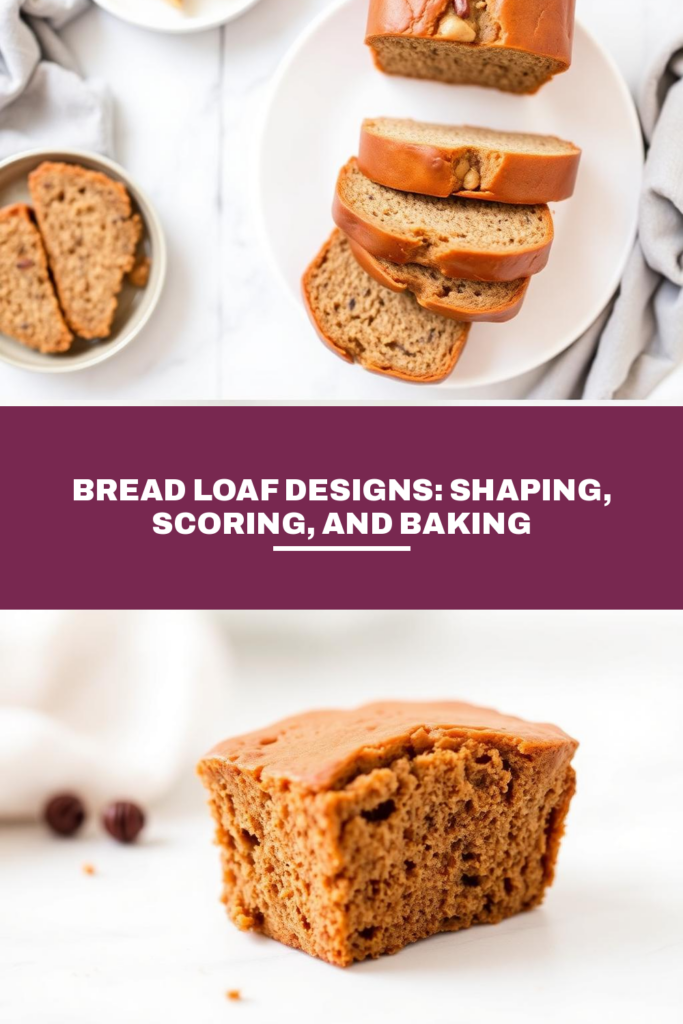
Bread loaf designs turn a plain baked loaf into a patterned, crackled, or seeded crust that stands out on the table. The texture you want—a crisp, golden crust with a soft, airy crumb—comes from shaping the dough tightly, scoring it just before baking, and using steam in the oven. This method works for any basic white or whole-wheat bread dough and gives you a professional-looking loaf at home.
Choose Your Design Before You Shape
Decide on the design before the dough is shaped, because different patterns need different shaping. A simple round boule works for a sunflower or wheat-stalk score. An oval batard suits diagonal slashes or a leaf pattern. A long baguette is for overlapping slashes. For a seeded crust, you need a wet dough surface and a plate of seeds ready at the bench.
Classic Scoring Patterns
- Single slash: One long cut down the center, slightly off-center, about 1/2 inch (1.25 cm) deep. Gives a clean, rustic ear.
- Diagonal slashes: Three to five parallel cuts at a 45-degree angle. Classic for batards and sandwich loaves.
- Crosshatch: Two sets of parallel slashes crossing each other. Creates a diamond pattern.
- Leaf pattern: One central vertical slash, then short angled slashes branching off both sides. Looks like a wheat stalk or leaf.
- Sunburst: A circle of slashes radiating from the center, like a sun. Best on a round boule.
Ingredients for a Basic Bread Dough
This recipe makes one large loaf (about 900 g / 2 lb) that serves 8–10. Use it for any of the designs above.
- 3 1/2 cups (440 g) bread flour, plus more for dusting
- 1 1/2 teaspoons (9 g) fine sea salt
- 1 teaspoon (4 g) instant yeast
- 1 1/2 cups (355 ml) warm water (about 105°F / 40°C)
- 1 tablespoon (15 ml) olive oil (optional, for a softer crust)
- For seeded designs: 1/2 cup (70 g) mixed seeds (sesame, poppy, sunflower, flax), plus 1 egg white beaten with 1 tablespoon water for the wash
Shape the Loaf for the Design
- In a large bowl, mix the flour, salt, and yeast. Add the water and olive oil (if using). Stir with a wooden spoon until a shaggy dough forms.
- Turn the dough onto a lightly floured surface. Knead for 8–10 minutes, until smooth and elastic. The dough should pass the windowpane test: stretch a small piece thin enough to see light through without tearing.
- Place the dough in a lightly oiled bowl, cover with plastic wrap or a damp towel, and let rise in a warm spot (about 75°F / 24°C) for 1 to 1 1/2 hours, until doubled in size.
- Turn the dough out onto a lightly floured surface. Gently press it into a rectangle about 8 by 10 inches (20 by 25 cm).
- For a batard (oval): Fold the long sides into the center, then roll up tightly from a short end. Pinch the seam closed.
- For a boule (round): Gather the edges to the center, then flip the dough over and cup your hands around it, rotating to create surface tension.
- Place the shaped dough seam-side down on a parchment-lined baking sheet or in a floured proofing basket. Cover loosely with plastic wrap. Let rise for 45–60 minutes, until puffy but not doubled. The dough should spring back slowly when poked.
Score and Bake for a Crisp Crust
- About 30 minutes before baking, place a cast-iron skillet or a metal baking pan on the bottom oven rack. Preheat the oven to 450°F (232°C).
- Just before baking, turn the risen loaf out onto a piece of parchment paper (if using a proofing basket). If you want a seeded crust, brush the top with the egg white wash and sprinkle generously with seeds.
- Using a sharp razor blade or a lame, make your chosen cuts. Hold the blade at a 30-degree angle to the dough, and cut about 1/2 inch (1.25 cm) deep. Work quickly and confidently—hesitation drags the dough.
- Slide the loaf (still on the parchment) onto the hot baking sheet or directly onto a preheated baking stone. Immediately pour 1 cup (240 ml) of hot water into the skillet to create steam. Close the oven door quickly.
- Bake for 10 minutes, then reduce the temperature to 425°F (218°C). Bake for another 20–25 minutes, until the crust is deep golden brown and the internal temperature reaches 190°F (88°C) on an instant-read thermometer. If the crust browns too fast, tent loosely with foil.
- Transfer to a wire rack. Cool completely before slicing, at least 1 hour. Slicing warm bread compresses the crumb.
Substitutions and Swaps
- All-purpose flour: Replace bread flour with 3 1/2 cups (420 g) all-purpose flour. The loaf will be slightly less chewy and rise a bit less.
- Whole-wheat flour: Use 2 cups (250 g) whole-wheat plus 1 1/2 cups (190 g) bread flour. Add 2 tablespoons (30 ml) extra water, as whole wheat absorbs more.
- No instant yeast: Use 2 1/4 teaspoons (7 g) active dry yeast dissolved in the warm water for 5 minutes before mixing.
- No olive oil: Omit it; the crust will be slightly crisper.
- Seeds: Use any combination you like. For a nuttier crust, toast the seeds in a dry skillet for 2–3 minutes before sprinkling.
Serve, Store, and Keep the Crust
Serve the bread warm or at room temperature with butter, olive oil, soups, or stews. The scored crust is especially good for tearing and dipping.
Store the loaf cut-side down on a cutting board at room temperature for up to 3 days. Do not refrigerate—it dries out faster. To freeze, wrap the cooled loaf tightly in plastic wrap and then foil; freeze for up to 3 months. Thaw at room temperature for 2–3 hours. To refresh a stale loaf, sprinkle it with water and bake at 350°F (177°C) for 5–10 minutes until crisp.
Why Scoring and Steam Matter
Scoring is not just decorative. The cuts control where the bread expands in the oven, preventing random tears. A shallow cut (less than 1/4 inch / 6 mm) will close up; a cut too deep (more than 3/4 inch / 2 cm) will deflate the loaf. Steam keeps the crust soft during the first 10 minutes of baking, allowing maximum oven spring. Without steam, the crust sets too early and the loaf cracks unpredictably.
If you do not have a cast-iron skillet, place a pan of water on the bottom rack and spray the loaf with water from a spray bottle every 2 minutes for the first 6 minutes of baking. This works but is less effective than a single pour of boiling water.
Common Design Mistakes and Fixes
- Slash closes up: Your blade was too dull or the dough was too soft. Use a razor blade and make sure the dough is well risen but not over-proofed.
- Crust is pale: Oven not hot enough. Preheat fully to 450°F (232°C) and use steam.
- Loaf bursts on the side: The score was too shallow or the dough was under-proofed. Cut 1/2 inch (1.25 cm) deep and let the dough rise until puffy.
- Seeds fall off: The egg wash was too thin or the dough surface was too dry. Brush a generous layer and press seeds gently into the dough.
If you are new to scoring, practice on a proofed loaf just before baking—you cannot redo a cut, but you can always bake a loaf with a few extra slashes.
Safe minimum internal temperatures follow USDA FSIS; raw-fish guidance follows the U.S. FDA. See our food safety notes.
Spotted an error? Tell us and we will correct it (corrections policy).