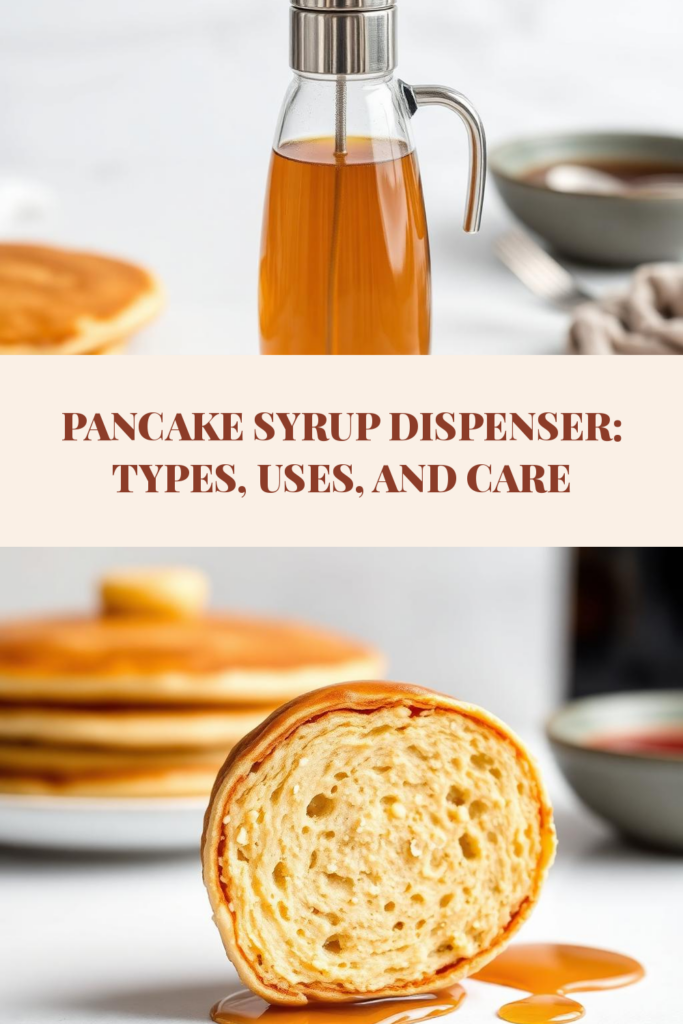
Time — varies by model, typically 1–2 minutes to fill and 5–10 minutes to clean · Serves — 1–8 people depending on capacity · The key step — choose a dispenser with a wide mouth for easy filling and a tip that drips cleanly. A pancake syrup dispenser is a small pitcher or bottle designed to hold maple syrup, honey, or pancake syrup and pour it onto pancakes, waffles, or French toast without drips or mess. It usually has a hinged cap, a narrow spout, and a handle for one-handed pouring.
Types of Syrup Dispensers
Syrup dispensers come in three main styles. The most common is a glass or plastic pitcher with a flip-top lid and a pointed spout. Another style is a squeeze bottle with a narrow tip, often used for honey or thinner syrups. A third style is a pump dispenser, which pushes syrup up through a tube and out a spout when you press a lever. Each works for warm or cold syrup, but glass holds heat better if you warm syrup first.
Glass vs. Plastic vs. Ceramic
Glass dispensers are heavy, easy to see through, and safe in the microwave for short bursts (check the manufacturer’s label). Plastic is lightweight and unbreakable, but can stain and absorb odors. Ceramic is attractive but heavier and more fragile. For everyday use, glass or BPA-free plastic with a tight lid is practical.
Choosing a Dispenser
Look for a dispenser with a wide mouth (at least 2 inches / 5 cm across) so you can fill it from a bottle or ladle without spilling. The spout should be narrow, about 1/4 inch (6 mm) at the tip, to control the stream. A flip-top lid that stays open while pouring is easier than a screw cap. Check that the handle is comfortable and the base is stable when full.
Capacity and Serving Size
Dispensers typically hold 8 to 24 ounces (240–710 ml). For a family of four, a 12-ounce (355 ml) dispenser serves about 8 pancakes with 1.5 ounces (45 ml) of syrup each. If you host brunch, a 24-ounce (710 ml) size works for a crowd. Smaller 8-ounce (240 ml) bottles are good for individual use or for honey.
Using a Syrup Dispenser
Fill the dispenser with your syrup of choice—maple syrup, pancake syrup, honey, or even melted butter if the dispenser is heat-safe. If you want warm syrup, heat it in a saucepan or microwave before pouring into the dispenser; do not heat the dispenser itself unless it is labeled microwave-safe. Pour slowly over pancakes, tilting the dispenser at a 45-degree angle to control the flow. After pouring, let the tip drip for a few seconds before setting it down to avoid sticky spots.
How to Clean and Store
Rinse the dispenser with hot water immediately after use. For sticky residue, fill it with warm soapy water and shake, then rinse thoroughly. Most glass and plastic dispensers are top-rack dishwasher-safe, but check the label. Dry the dispenser upside down on a rack before storing. Store syrup in the refrigerator after opening if the label says so; most pure maple syrup needs refrigeration after opening, while commercial pancake syrup can stay in a pantry. Refrigerated syrup should be used within 6 months for best quality.
Common Syrup Dispenser Problems
Dripping spout: If the spout drips after pouring, the tip may be too wide or the lid may not seal. Choose a dispenser with a narrow tip and a tight-fitting cap. You can also wipe the tip with a damp cloth after each pour.
Clogged tip: Crystallized honey or sugar syrup can block the opening. Soak the tip in hot water for 5 minutes to dissolve the crystals, then rinse. Avoid putting honey in a dispenser with a very narrow tip if it crystallizes quickly.
Hard to fill: A narrow mouth causes spills. Use a funnel or choose a dispenser with a wide mouth. If you already have a narrow-mouth bottle, pour syrup through a small funnel.
Safety and Shelf Life
Syrup that is left out at room temperature for more than 2 hours should be refrigerated if it contains dairy or eggs (like some pancake syrups with butter). Pure maple syrup can sit out for a few hours but is best refrigerated after opening. Check the label for the specific storage instruction. If you see mold or an off smell, discard the syrup. Never taste syrup to check safety—if in doubt, throw it out.
Ingredients
- 1 cup (240 ml) maple syrup or pancake syrup
- Optional: 2 tbsp (30 ml) butter, melted (for warm butter syrup)
Instructions
- Warm the syrup in a saucepan over low heat for 2–3 minutes, or in a microwave-safe bowl for 30 seconds, until it is warm but not boiling. (If using butter, stir it into the warm syrup until melted.)
- Pour the warm syrup into the dispenser, filling it no more than three-quarters full to allow for expansion.
- Close the lid and serve immediately, pouring over pancakes or waffles.
- After serving, wipe the spout with a damp cloth and refrigerate any leftover syrup in a sealed container within 2 hours.
For a thicker, richer syrup, use 1 cup (240 ml) maple syrup and 1/4 cup (60 ml) heavy cream, heated together until warm. This makes a cream syrup that is less sweet and more indulgent, but it must be refrigerated and used within 4 days.
If you prefer a lower-sugar option, use a sugar-free pancake syrup; it works the same way but may be thinner. For a honey-based syrup, use 1 cup (240 ml) honey and 2 tbsp (30 ml) water, warmed together—this will be thicker and crystallize faster, so store it in the fridge and reheat gently.
Related
- Cucumber Simple Syrup Recipe for Drinks
- Grapefruit Simple Syrup Recipe for Drinks and Desserts
- Tangerine Simple Syrup Recipe for Drinks and Desserts
Safe minimum internal temperatures follow USDA FSIS; raw-fish guidance follows the U.S. FDA. See our food safety notes.
Spotted an error? Tell us and we will correct it (corrections policy).