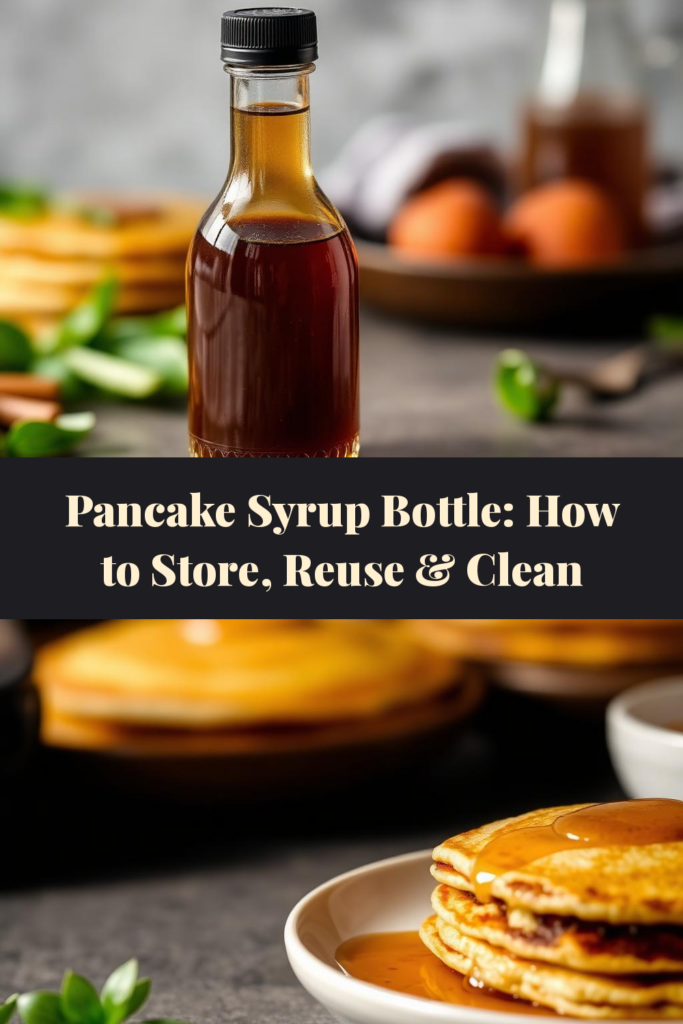
Pancake syrup bottles are the everyday container for breakfast syrup, whether it is maple syrup, corn syrup, or a maple-flavored blend. Knowing how to store, reheat, and clean the bottle keeps the syrup flowing and prevents sticky messes. This page covers the right way to store syrup in its bottle, how to reuse a bottle for homemade syrup, and how to clean a clogged or sticky bottle.
Storing Syrup in the Bottle
Store an opened bottle of pancake syrup in the refrigerator. Refrigeration keeps the syrup fresh and prevents mold growth, especially in syrups without preservatives. Unopened bottles can stay in a cool, dark pantry for up to 1 year, but check the label for a “best by” date.
Refrigerated syrup will thicken and may crystallize slightly; this is normal. To make it pour easily, warm the bottle in a bowl of hot water for 5–10 minutes, or microwave the syrup in a separate microwave-safe container in 15-second bursts, stirring between bursts, until it reaches the desired consistency. Do not microwave the plastic bottle itself, as it can warp or melt.
Syrup Shelf Life and Safety
Once opened, real maple syrup keeps in the refrigerator for 6–12 months. Pancake syrups that are mostly corn syrup and high-fructose corn syrup, with preservatives, can keep for 6–9 months refrigerated. If you see mold, a sour smell, or an off taste, discard the syrup. Do not taste syrup to check safety; rely on visual and smell cues.
If you make your own syrup (like a simple sugar syrup or fruit syrup), store it in the refrigerator and use within 2 weeks. Homemade syrups without preservatives spoil faster than commercial ones.
Reusing a Syrup Bottle
You can reuse a clean pancake syrup bottle for homemade syrup, salad dressing, or other liquids. To clean it thoroughly, first empty the bottle and rinse with hot water. Then fill it halfway with hot water and a few drops of dish soap, cap it, and shake vigorously. Rinse well with hot water, then with a diluted vinegar solution (1 part white vinegar to 3 parts water) to remove any lingering syrup residue and odors. Rinse again with hot water and let it air-dry completely before refilling.
If the bottle has a narrow neck, use a bottle brush to scrub the inside. For stubborn syrup residue, soak the bottle in hot soapy water for 30 minutes before scrubbing.
Cleaning a Clogged Syrup Bottle
Syrup can crystallize or become sticky and clog the nozzle or cap. To unclog, remove the cap and soak it in hot water for 10 minutes. For the bottle, fill it with hot water and let it sit for 10–15 minutes, then shake and rinse. If the clog persists, use a toothpick or a small skewer to gently clear the opening, being careful not to scratch the plastic.
For a bottle with a flip-top cap, clean under the flap with a cotton swab dipped in hot water. Dry the cap thoroughly before replacing to prevent sticking.
Making Your Own Syrup in a Bottle
If you want to fill a clean bottle with homemade pancake syrup, here is a simple recipe. This makes about 2 cups (480 ml) of syrup.
Ingredients
- 1 cup (200 g) granulated sugar
- 1 cup (240 ml) water
- 1/2 teaspoon maple extract (or 1/4 teaspoon vanilla extract for a different flavor)
- Pinch of salt (optional, to balance sweetness)
Instructions
- In a small saucepan, combine the sugar and water. Bring to a boil over medium-high heat, stirring until the sugar dissolves.
- Reduce heat to low and simmer for 5 minutes, without stirring, until the syrup thickens slightly.
- Remove from heat and stir in the maple extract and salt, if using.
- Let the syrup cool to room temperature, about 20 minutes.
- Pour the syrup into a clean, dry bottle using a funnel. Seal and refrigerate.
Use within 2 weeks. The syrup will thicken when cold; warm it as described above to thin it out.
Scaling Syrup Batches
This simple syrup recipe scales easily. Use the table below for half, single, and double batches.
| Batch | Sugar | Water | Maple Extract | Yield |
|---|---|---|---|---|
| Half | 1/2 cup (100 g) | 1/2 cup (120 ml) | 1/4 teaspoon | 1 cup (240 ml) |
| Single | 1 cup (200 g) | 1 cup (240 ml) | 1/2 teaspoon | 2 cups (480 ml) |
| Double | 2 cups (400 g) | 2 cups (480 ml) | 1 teaspoon | 4 cups (960 ml) |
Bottle Types and What to Use Instead
Pancake syrup bottles come in plastic squeeze bottles with flip-top caps or screw caps, and glass bottles. Plastic squeeze bottles are convenient for drizzling, but they can be harder to clean thoroughly. Glass bottles are easier to sanitize and are good for storing homemade syrups, but they are heavier and can break.
If you don’t have a syrup bottle, you can use a glass jar with a tight lid, a mason jar, or a condiment squeeze bottle with a narrow nozzle. For serving, a small pitcher or a gravy boat works well.
Storing Syrup for Later Use
If you make a large batch of syrup, you can freeze it in freezer-safe containers or ice cube trays. Freeze syrup in 1-cup (240 ml) portions, leaving 1/2 inch (1.3 cm) headroom for expansion. Thaw in the refrigerator overnight, then warm before serving. Frozen syrup keeps for up to 6 months.
For commercial syrup, freezing is not necessary if you refrigerate it, but it can extend the shelf life beyond the recommended time. Always label containers with the date so you know how long they have been stored.
When to Discard a Syrup Bottle
If a plastic syrup bottle develops cracks, a persistent odor, or cannot be cleaned thoroughly, replace it. Cracks can harbor bacteria and cause leaks. If you see mold inside the bottle, discard the bottle and the syrup. Do not reuse a bottle that held syrup with mold, as spores can be difficult to remove completely.
For glass bottles, if the cap no longer seals tightly, replace the cap or use a different container. A tight seal is necessary to keep syrup fresh and prevent contamination.
Related
- Vinaigrette Dressing Nutrition: What’s in Your Bottle
- Cucumber Simple Syrup Recipe for Drinks
- Grapefruit Simple Syrup Recipe for Drinks and Desserts
Safe minimum internal temperatures follow USDA FSIS; raw-fish guidance follows the U.S. FDA. See our food safety notes.
Spotted an error? Tell us and we will correct it (corrections policy).