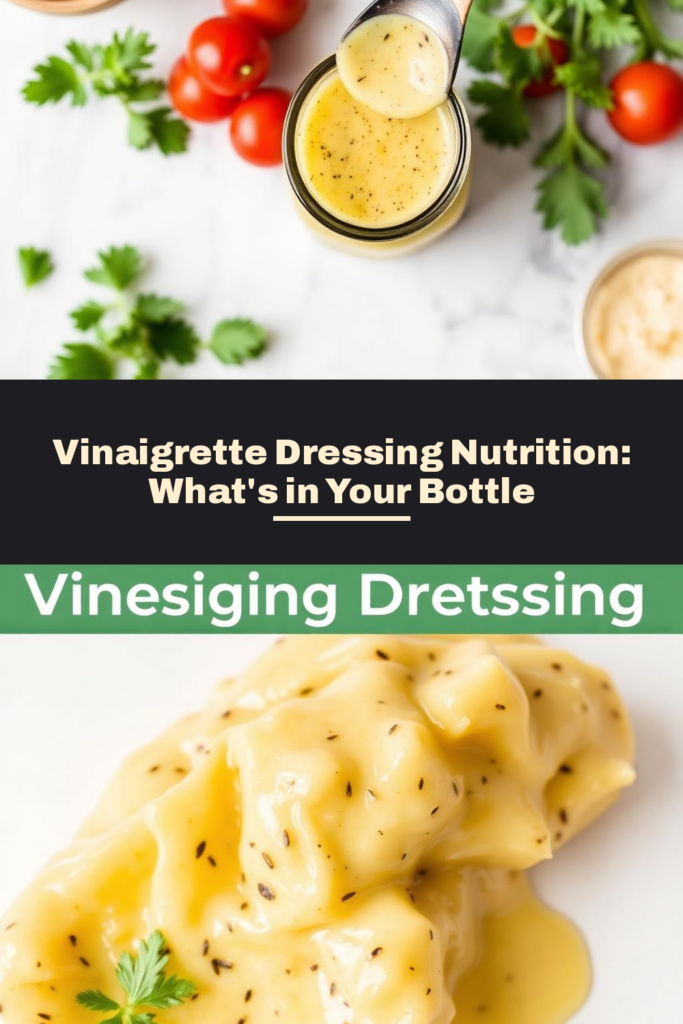
Vinaigrette is a simple emulsion of oil and vinegar, usually with a little mustard, salt, and pepper, and it is the most common salad dressing in American kitchens. Its nutrition depends almost entirely on the oil-to-vinegar ratio and any added sugar, so a standard recipe is about 170–200 calories per 2-tablespoon serving, with 18–20 g of fat and 1–2 g of carbs. The list below is for a basic vinaigrette; every variation changes the numbers.
Ingredients
- 1/4 cup (60 ml) red wine vinegar or white wine vinegar
- 1 tsp (5 g) Dijon mustard
- 1/2 tsp (3 g) salt
- 1/4 tsp (0.5 g) black pepper
- 1/2 cup (120 ml) extra-virgin olive oil
Instructions
- In a small bowl, whisk together the vinegar, mustard, salt, and pepper until the salt dissolves.
- While whisking constantly, add the olive oil in a slow, steady stream. Whisk until the dressing is emulsified and slightly thickened, about 1 minute.
- Use immediately, or store in a sealed jar and shake before using.
How Many Calories and How Much Fat Are in a Serving?
A standard 2-tablespoon (30 ml) serving of this vinaigrette has about 180 calories, 19 g of fat, 2 g of carbohydrates, and 0 g of protein. The fat is almost entirely from the olive oil, which is mostly monounsaturated fat. If you use a different oil, the calorie count stays about the same; the fat type changes. For example, canola oil has less saturated fat than coconut oil, but the total calories per tablespoon of oil are roughly equal.
If you want a lower-calorie dressing, reduce the oil to 1/3 cup (80 ml) and increase the vinegar to 1/3 cup (80 ml). That version has about 140 calories per 2-tablespoon serving. If you add a teaspoon of honey or sugar, add about 20 calories and 5 g of carbs per serving.
What Does the Nutrition Label on Store-Bought Vinaigrette Mean?
Store-bought vinaigrettes often list nutrition per 2 tablespoons (30 ml), but the serving size can vary by brand. Check the label for the serving size and the ingredient list. Many commercial dressings contain added sugar, corn syrup, or thickeners, which raise the carbohydrate count. A typical bottled vinaigrette has 120–200 calories per 2-tablespoon serving, with 10–18 g of fat and 3–8 g of carbs. Some “light” versions have about 60–80 calories per serving, but they often replace oil with water and thickeners, which changes the texture and flavor.
If you are tracking fat or calories, measure the dressing with a spoon or a kitchen scale. A 2-tablespoon serving is about 30 g by weight. Many people pour more than that, which can double the calories.
How Long Does Vinaigrette Keep?
Homemade vinaigrette without any fresh garlic, herbs, or shallots can be stored in a sealed container in the refrigerator for up to 2 weeks. The oil will solidify when cold, so take it out 15–20 minutes before use, or run the jar under warm water for a few seconds, then shake well. If you add fresh garlic, shallots, or herbs, refrigerate and use within 4 days to reduce the risk of botulism. Never leave vinaigrette with fresh garlic or herbs at room temperature. Store-bought vinaigrette should be refrigerated after opening and used by the date on the label, usually within 1–3 months.
Vinaigrette does not freeze well because the emulsion breaks and the texture becomes watery when thawed. If you must freeze it, freeze in an ice cube tray, then thaw in the refrigerator and shake vigorously; it will not be as smooth.
Vinaigrette Variations and How They Change Nutrition
Lemon-Herb Vinaigrette
Replace the vinegar with 1/4 cup (60 ml) fresh lemon juice and add 1 tbsp (4 g) chopped fresh parsley or chives. The lemon juice adds about 15 calories and 4 g of carbs per batch, so per serving it adds about 2 calories and 0.5 g of carbs. Use within 4 days because of the fresh herbs.
Balsamic Vinaigrette
Use balsamic vinegar instead of red wine vinegar. Balsamic vinegar has about 14 calories and 3 g of carbs per tablespoon, so a 1/4 cup (60 ml) adds about 56 calories and 12 g of carbs to the whole batch, or about 7 calories and 1.5 g of carbs per serving. It is slightly sweeter and thicker than red wine vinegar.
Honey-Mustard Vinaigrette
Add 1 tbsp (21 g) honey and increase the mustard to 1 tbsp (15 g). This adds about 60 calories and 17 g of carbs to the batch, or about 8 calories and 2 g of carbs per serving. The honey also helps the emulsion hold longer.
How to Use Vinaigrette Without Overdoing Calories
To keep a salad moderate in calories, use about 1 tablespoon (15 ml) of vinaigrette for every 2 cups (80 g) of greens. That is roughly 90 calories. If you add higher-calorie toppings like cheese, nuts, or croutons, you may want to use less dressing. For a main-dish salad with chicken or beans, a 2-tablespoon serving is reasonable. You can also toss the salad with the dressing just before serving; this coats the leaves evenly with less dressing than pouring it on top.
If you are watching sodium, note that the 1/2 tsp of salt in this recipe adds about 290 mg of sodium per serving. Store-bought vinaigrettes often have 200–400 mg per serving. To reduce sodium, use 1/4 tsp of salt and add a squeeze of lemon or extra vinegar to boost flavor.
Vinaigrette for Meal Prep and Large Batches
This recipe scales up easily. For a week of salads, make a double batch (1 cup oil, 1/2 cup vinegar) and store it in a jar. It will keep for 2 weeks in the refrigerator if it has no fresh garlic or herbs. Shake well before each use. For a large party, make a triple batch and set out a small pitcher or squeeze bottle so guests can dress their own salads. If you are making a big batch, consider using a blender or a jar with a tight lid to emulsify more efficiently.
What About “Healthy” Vinaigrettes?
Some dressings are marketed as “healthy” because they are oil-based, but the term has no official definition. The nutrition facts are what matter. Compare the serving size, calories, fat, and added sugar on the label. A vinaigrette with more oil and less sugar is generally lower in carbs, but it is still high in calories. There is no evidence that any particular oil or vinegar has special health effects beyond its basic nutrients. Choose the one you like and use it in moderation.
Vinaigrette Nutrition for Common Serving Sizes
| Serving size | Calories | Fat (g) | Carbs (g) |
|---|---|---|---|
| 1 tbsp (15 ml) | 90 | 9.5 | 1 |
| 2 tbsp (30 ml) | 180 | 19 | 2 |
| 1/4 cup (60 ml) | 360 | 38 | 4 |
These numbers are for the basic recipe. If you add honey or use balsamic vinegar, the carb count goes up as shown in the variations.
Related
- How to Make Apple Cider Vinaigrette Dressing
- Banana Bread Loaf Calories and Nutrition Facts
- Coconut Milk Chia Pudding Nutrition Facts
Safe minimum internal temperatures follow USDA FSIS; raw-fish guidance follows the U.S. FDA. See our food safety notes.
Spotted an error? Tell us and we will correct it (corrections policy).