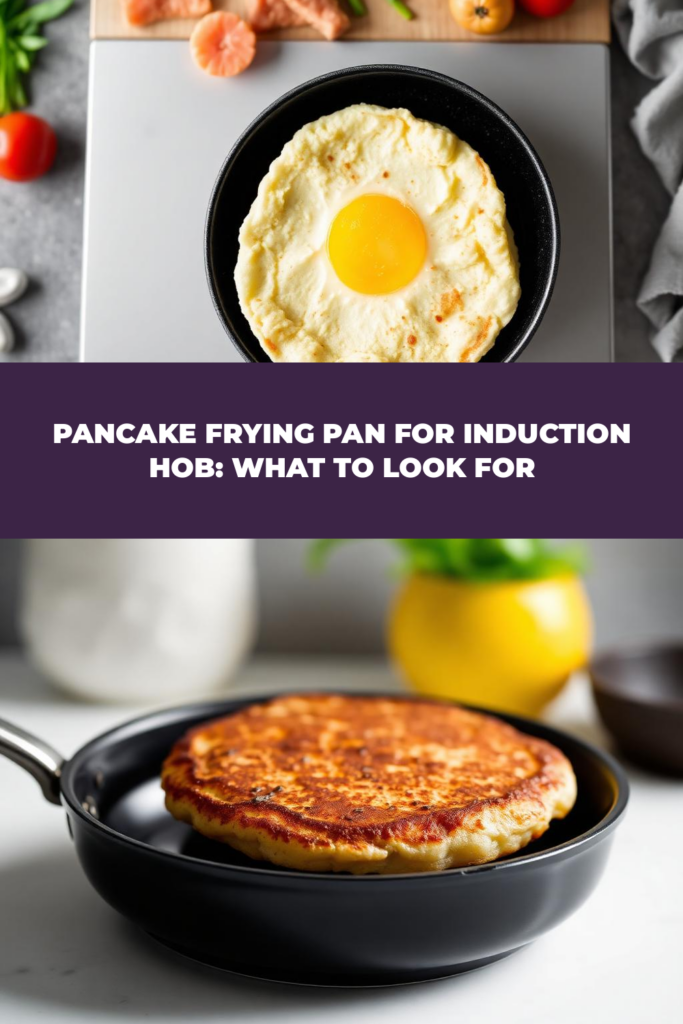
Time: 2 minutes to check · Serves: one pan · The key step: a magnet must stick firmly to the base. A pancake pan for an induction hob needs a flat, ferromagnetic base that covers the hob’s induction zone; not every nonstick pan works, so you check before you buy.
Why Induction Needs a Special Pan
Induction hobs heat by generating a magnetic field that only works with ferromagnetic metal—cast iron, enameled steel, or stainless steel with a magnetic grade. Aluminum and most standard nonstick pans have no magnetic response, so they stay cold. The pan’s base must also be flat and at least as wide as the hob’s induction ring (usually 4.5–7 inches / 11–18 cm); a smaller base will not heat evenly. The symbol to look for is a coil icon, but the reliable test is a fridge magnet: if it sticks to the base, the pan is induction-compatible.
What to Check Before Buying
Base Material and Thickness
Induction heats the pan base directly, so a thin base can warp or develop hot spots. Look for a pan with a base at least 0.1 inch (2.5 mm) thick, ideally with an encapsulated aluminum or copper disc inside a magnetic stainless steel layer. This gives even heat without the pan being too heavy. Cast iron and enameled cast iron work as-is, but they are heavier and slower to heat.
Size and Shape
For pancakes, a pan with low, sloped sides (about 1 inch / 2.5 cm high) makes flipping easier. Diameter options: 8-inch (20 cm) for small pancakes, 10-inch (25 cm) for standard, and 12-inch (30 cm) for large or multiple at once. Measure your hob’s largest induction ring; the pan base should match it or be slightly larger. A pan with a base smaller than the ring will heat only in the center.
Nonstick Coating and Care
Nonstick coatings (PTFE or ceramic) make pancakes release easily with little butter or oil. PTFE-coated pans are durable but should not be heated empty above medium; ceramic coatings are more scratch-prone but can take slightly higher heat. Both need hand washing and soft utensils. If you prefer no coating, a well-seasoned cast iron pan works, but you will need more fat to prevent sticking.
How to Test Your Current Pan
If you already own a frying pan, do the magnet test: place a strong magnet on the outside base. If it sticks firmly and the base is flat (no concave or convex bowing), it will work on induction. If the magnet slides or falls, the pan is not compatible. Also check the base for a stamped symbol—many pans show a coil icon or the word “induction.” If the base is slightly warped (rocking on a flat surface), it will heat unevenly and may not make good contact with the hob.
Using the Pan on Induction
Heat Settings and Preheating
Induction heats fast, so start on medium (about 350°F / 175°C on the hob’s dial) and let the pan preheat for 2–3 minutes. A drop of water should sizzle and evaporate quickly when the pan is ready. For pancakes, keep the heat at medium-low to medium; too high burns the outside before the middle sets. If your hob has a power boost, avoid it for pancakes—it will scorch the butter.
Flipping and Cooking
Use a thin metal or silicone spatula. Slide it under the pancake’s edge; if it releases easily, flip. If it resists, cook 30 seconds more. A typical pancake takes 2–3 minutes per side on induction, but times vary by batter and pan thickness. The first pancake often tests the heat—adjust down if it browns too fast.
Common Problems and Fixes
Pan Not Detected by the Hob
If the hob shows an error or flashes “no pan,” the base is not magnetic or is too small. Check the magnet test and the ring size. Some hobs require a minimum base diameter (often 4.5 inches / 11 cm). A pan with a magnetic stainless steel base but a thin aluminum core may still fail if the magnetic layer is too thin—test with a strong magnet, not a weak fridge magnet.
Uneven Browning
This usually means the pan base is warped or the ring is larger than the base. Move the pan to a smaller ring or use a pan that matches the ring. Also, let the pan preheat fully; cold spots cause pale patches. If the center burns but edges stay pale, the pan is too thin—use a lower heat and longer preheat.
Coating Peeling or Scorching
Never heat an empty nonstick pan on high; it damages the coating. On induction, high heat can exceed the coating’s safe limit. Keep the heat at medium and always add butter or oil before the pan gets too hot. If the coating is already peeling, replace the pan—flakes can end up in food.
Storage and Care
After cooking, let the pan cool before washing. Wash with warm soapy water and a soft sponge; avoid abrasive pads and dishwasher detergent, which strip nonstick. Dry immediately to prevent rust on cast iron or water spots on stainless. Store with a paper towel between stacked pans to protect the coating. A well-cared-for nonstick pan lasts 2–3 years; cast iron lasts decades if seasoned. Do not store food in the pan—transfer leftovers to a container and refrigerate within 2 hours.
Related
- 10 One Pan Paleo Dinner Ideas for Quick Cleanup
- Bread Loaf Tray: How to Bake a Loaf on a Sheet Pan
- Bread Loaf Dimensions: Standard Sizes and Pan Guide
Safe minimum internal temperatures follow USDA FSIS; raw-fish guidance follows the U.S. FDA. See our food safety notes.
Spotted an error? Tell us and we will correct it (corrections policy).