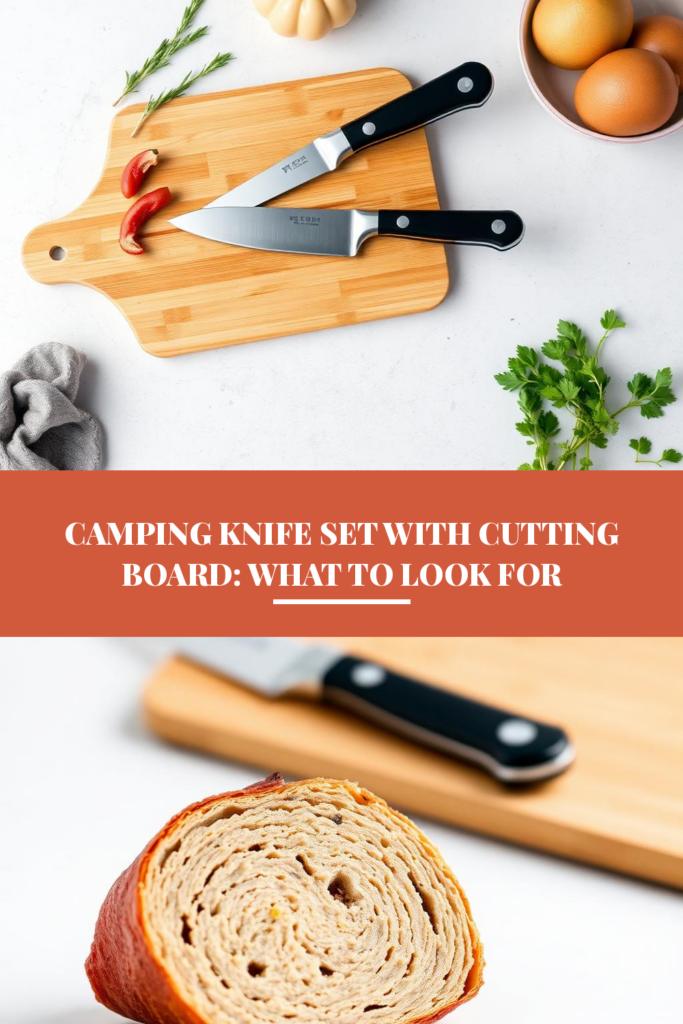
Time to choose: 10–15 minutes · What you get: a compact knife set that packs flat · The key step: match blade steel and board material to how you cook over fire. A camping knife set with cutting board is a single carry kit that pairs one or more knives with a board that doubles as a cutting surface and often a carrying case. It suits car camping, RV trips, tailgating, and any outdoor meal where you want one organized tool rather than loose knives.
What Should a Camping Knife Set With Cutting Board Include?
A useful set holds the knives you actually use outdoors: a chef’s knife (6–8 inches / 15–20 cm blade), a paring knife (3–4 inches / 8–10 cm), and sometimes a serrated utility knife for bread or tomatoes. The cutting board should be at least 10 by 14 inches (25 by 35 cm) so you can chop a full onion or slice a loaf. Many sets add a small honing rod, a bottle opener, or a fork, but those are extras—the core is the two knives and the board.
Check that the board has a non-slip edge or feet. A wet camp table is a bad place for a sliding board. The board should be at least 0.5 inch (1.3 cm) thick if it’s wood, or 0.25 inch (0.6 cm) if it’s plastic, so it does not warp or flex under pressure.
Which Knife Steel Is Best for Camping?
Stainless steel is the practical choice because it resists rust from humidity, morning dew, and food acids. Look for blades labeled 420HC, 440A, or 8Cr13MoV—all are stainless, easy to sharpen, and hold an edge long enough for a weekend. Avoid high-carbon steel (like 1095) unless you are prepared to oil the blades after every use; it stains and rusts quickly outdoors.
Blade hardness matters less than edge retention for camping. A blade around 56–58 HRC (Rockwell hardness) is a good balance: it takes a sharp edge and does not chip easily on a plastic board. Softer blades (below 54 HRC) dull fast; harder blades (above 60 HRC) can chip if you hit bone or a hard board.
What Cutting Board Material Works Outdoors?
Three materials dominate: plastic (polypropylene or HDPE), bamboo, and wood (maple, walnut, or acacia). Plastic is the most camping-friendly: it is lightweight, waterproof, dishwasher-safe, and easy to sanitize. Bamboo is harder than most wood, resists moisture well, but can dull knives slightly faster. Wood (maple or walnut) is gentle on edges and looks good, but it needs oiling and must dry fully before storage to avoid cracking.
For a set that lives in a car or backpack, choose plastic or bamboo. If you want a board that also serves as a serving platter at camp, wood is better. Avoid glass or stone boards—they dull knives quickly and are heavy.
How Should the Knives and Board Pack Together?
The best sets have a dedicated slot or sleeve for each knife, and the board either slides into a canvas case or has a fitted cover. The board should fully cover the knife blades when closed, so nothing pokes out. A locking latch or strap keeps the board from opening in transit. Check that the knives do not rattle—a tight fit prevents edge damage and accidental cuts when you reach into a bag.
Some sets come with a leather or nylon roll that holds the knives separately, and the board is a separate piece. That is fine, but then you have two items to carry. A single-unit set (board closes like a book over the knives) is more convenient for quick access at a campsite.
How Much Should a Camping Knife Set Weigh and Cost?
Weight matters if you hike to camp. A complete set with a 7-inch chef’s knife, a 3.5-inch paring knife, and a 12-by-16-inch plastic board typically weighs 1.5 to 2.5 pounds (680 g to 1.1 kg). Wood boards add weight—a similar set with a maple board can reach 3.5 pounds (1.6 kg). For car camping, weight is less critical; for backpacking, look for a set under 2 pounds.
Price ranges widely: basic plastic-board sets start around $25–40, mid-range stainless sets with bamboo run $50–80, and premium wood-board sets with better steel can exceed $100. You do not need the most expensive set—a $40 set with 420HC steel and a plastic board will handle most camp meals for years if you keep the blades dry.
What Should You Check Before Buying?
Hold the chef’s knife. The handle should fit your grip comfortably and not slip when wet. Look for a full tang (the metal runs the full length of the handle) or at least a secure three-rivet attachment. A folding knife in a set is rarely as sturdy as a fixed blade—prefer fixed blades for camp cooking.
Test the board’s surface. It should be smooth, without deep grain that traps food. Run your fingernail across it—if it catches, bacteria can hide. The board should be at least 0.25 inch thick for plastic, and the edges should be rounded so they do not dig into your palm.
Check the case or cover. It should have a drain hole or be easy to shake out, because moisture will collect after washing. A set that cannot dry fully will develop mildew smells within a season.
How Do You Care for a Camping Knife Set?
Wash knives by hand with warm soapy water and dry immediately. Do not put wood boards in the dishwasher—they will crack. Plastic boards can go in the dishwasher, but the heat may warp thin boards; hand washing is safer. After washing, store the set open or with the board slightly ajar until fully dry, then close it.
Oil wooden boards monthly with food-grade mineral oil (not cooking oil, which goes rancid). Rub a thin coat over the entire board, let it sit 20 minutes, then wipe off excess. Do not oil plastic boards. Sharpen knives with a honing rod before each trip and a whetstone (800–1000 grit) once or twice a year, depending on use.
How Long Will a Camping Knife Set Last?
With proper care, stainless steel blades and a plastic board last 5–10 years of regular camping. Wood boards last 3–5 years before deep cuts and warping make them unsafe—replace a wood board if it develops cracks that cannot be cleaned out. Check hinges and latches each season; a broken latch can expose blades in your bag.
If you use the set weekly, expect to sharpen blades every 2–3 months. If you use it a few weekends a year, a yearly sharpening is enough. A dull knife is more dangerous than a sharp one because it slips, so keep edges maintained.
Camping Knife Set for Large Groups and Kids
For a group of six or more, buy a set with a larger board (at least 16 by 20 inches / 40 by 50 cm) and an extra chef’s knife so two people can prep at once. Some sets include a serrated knife for bread—useful for group meals with sandwiches or loaves. For kids, do not buy a separate set; instead, keep the paring knife in a locked case and teach them to use it under supervision. A folding knife with a locking blade is safer for older kids than a loose fixed blade.
If you cook for a crowd, consider a set that includes a cleaver for breaking down whole chickens or vegetables. A cleaver adds weight, but it replaces a heavy chef’s knife for many tasks. Check that the board is thick enough (0.75 inch / 2 cm) to absorb cleaver blows without cracking.
What Are the Best Alternatives to a Pre-Made Set?
If no set fits your needs, build your own: buy a 7-inch chef’s knife and a 3.5-inch paring knife separately, plus a 12-by-16-inch plastic cutting board. Wrap the knives in a canvas roll or use blade guards. This lets you choose better steel (e.g., VG-10) and a board you like, and it often costs the same as a mid-range set. The downside is no single case—you must pack the pieces separately.
Another alternative is a folding knife with a locking blade and a small folding cutting board. These are compact for backpacking but are less stable for heavy chopping. For car camping, the pre-made set is usually more convenient because it keeps everything together.
Related
- Pasta Omelette for Breakfast: Crisp, Set, and Satisfying
- Bread Loaf Knife: How to Slice Even Slices
- Coconut Milk Pudding with Gelatin: Easy Set
Safe minimum internal temperatures follow USDA FSIS; raw-fish guidance follows the U.S. FDA. See our food safety notes.
Spotted an error? Tell us and we will correct it (corrections policy).