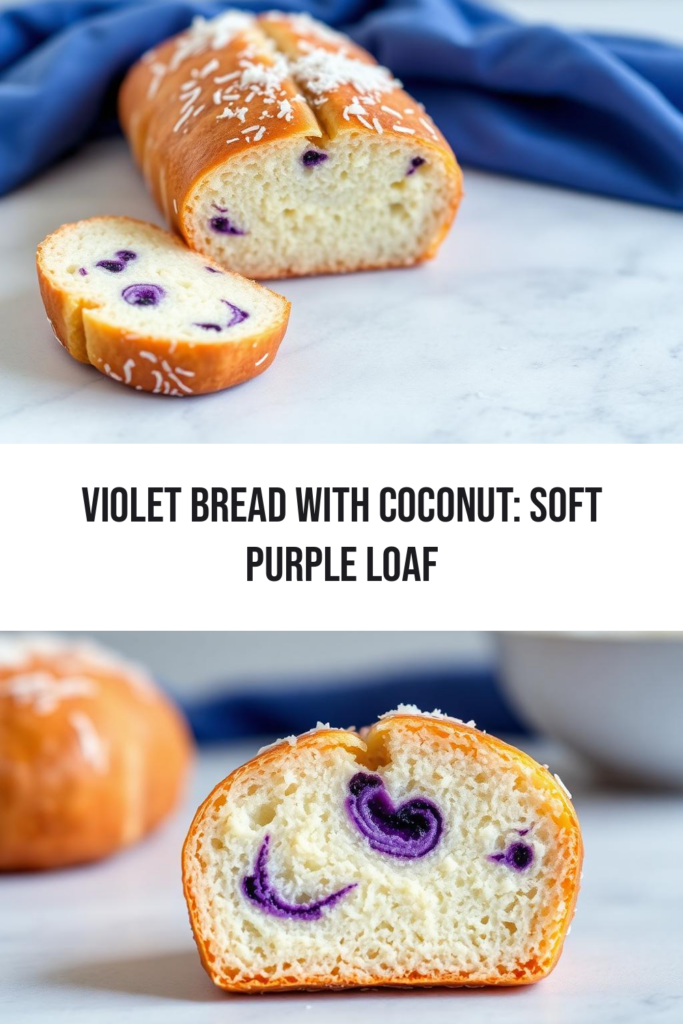
Time: 2 hr 45 min · Serves: 10 · The key step: Bloom the ube (purple yam) powder in warm milk to develop the violet color and coconut flavor before adding to the dough.
This is a soft, lightly sweetened yeast bread tinted violet with ube powder and filled with shredded coconut. It tastes like a mild vanilla-coconut loaf with a tender crumb, and it suits breakfast, an afternoon snack, or a lunchbox treat. The color comes entirely from the ube powder, so the bread stays naturally purple without artificial dye.
Ingredients
- 1 cup (240 ml) whole milk, warmed to 110°F (43°C)
- 2¼ tsp (7 g) active dry yeast (one packet)
- 3 tbsp (45 g) granulated sugar
- 3 tbsp (30 g) ube (purple yam) powder
- 3½ cups (440 g) all-purpose flour, plus more for dusting
- 1 tsp (5 g) salt
- 1 large egg, room temperature
- 3 tbsp (42 g) unsalted butter, melted and cooled
- 1 cup (85 g) unsweetened shredded coconut
- 1 tsp (5 ml) vanilla extract
Instructions
- In a small bowl, whisk the warm milk, yeast, and 1 tbsp of the sugar. Let stand for 5–10 minutes until frothy. If it does not foam, the yeast is inactive; start over with fresh yeast.
- In a large bowl, whisk the ube powder with ½ cup (120 ml) of the warm milk mixture until smooth. Add the remaining milk mixture, the rest of the sugar, the egg, melted butter, and vanilla. Stir until combined.
- Add the flour and salt. Stir with a wooden spoon until a shaggy dough forms. Turn out onto a lightly floured surface and knead for 8–10 minutes, until smooth and elastic. The dough will be slightly sticky; add flour 1 tbsp at a time only if needed.
- Knead in the shredded coconut until evenly distributed, about 2 minutes. Shape into a ball.
- Place the dough in a lightly oiled bowl, cover with plastic wrap or a damp towel, and let rise in a warm spot (75–80°F / 24–27°C) for 1 to 1½ hours, until doubled in size.
- Punch down the dough. On a lightly floured surface, shape it into a loaf and place in a greased 9×5-inch (23×13 cm) loaf pan. Cover and let rise again for 45–60 minutes, until the dough rises just above the pan rim.
- Preheat the oven to 350°F (175°C). Bake for 30–35 minutes, until the top is deep golden-brown and the internal temperature reaches 190°F (88°C) on an instant-read thermometer. If the top browns too quickly, tent loosely with foil after 20 minutes.
- Cool in the pan on a wire rack for 10 minutes, then turn out and cool completely before slicing.
Color and Flavor Adjustments
The ube powder gives both color and a mild, nutty-sweet flavor. If you want a deeper violet, increase the ube powder to 4 tbsp (40 g) and reduce the flour by 1 tbsp (8 g). The coconut adds texture; use sweetened shredded coconut for a sweeter loaf, but reduce the sugar to 2 tbsp (25 g) to balance.
If ube powder is not available, you can use 2 tbsp (30 g) of mashed cooked purple yam or purple sweet potato, but the color will be less vivid and the dough will be slightly wetter—add an extra 2 tbsp (16 g) of flour if needed. Do not use ube extract alone; it lacks the color and flavor depth.
Storage and Make-Ahead
Store the cooled loaf in an airtight container or wrapped in plastic wrap at room temperature for up to 3 days. For longer storage, wrap tightly and freeze for up to 3 months; thaw at room temperature for 2–3 hours before serving. To refresh, warm slices in a toaster or in a 300°F (150°C) oven for 5 minutes.
The dough can be prepared through step 5, then refrigerated overnight. The next day, let it sit at room temperature for 30 minutes before shaping and proceeding with the second rise.
What Can Go Wrong
Dull gray color instead of violet happens when the ube powder is not fully dissolved before adding flour. Always whisk it into the warm milk first, and make sure the milk is not hotter than 115°F (46°C) or it can kill the yeast.
Dense, heavy crumb usually means the dough was over-floured during kneading or the second rise was cut short. The dough should be soft and slightly tacky; resist adding more than 1–2 tbsp of extra flour. The second rise should take at least 45 minutes.
Coconut sinking to the bottom occurs when the coconut is added too early or the dough is too wet. Add the coconut only after the dough is smooth, and make sure it is thoroughly kneaded in. If the dough seems slack, let it rest 5 minutes before shaping.
For a dairy-free version, use oat milk and coconut oil instead of butter; the crumb will be slightly more tender and the coconut flavor stronger. Check that your ube powder is labeled gluten-free if you need that.
Safe minimum internal temperatures follow USDA FSIS; raw-fish guidance follows the U.S. FDA. See our food safety notes.
Spotted an error? Tell us and we will correct it (corrections policy).





