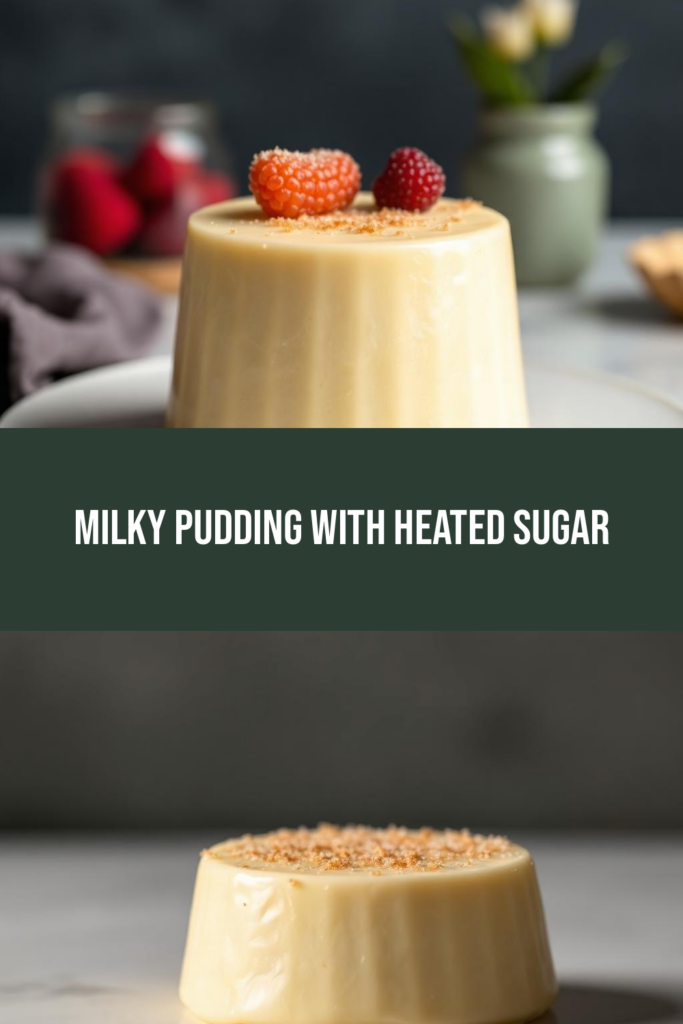
Milky pudding with heated sugar is crème brûlée: a rich, vanilla-scented custard baked until just set, then topped with a thin, crackling layer of caramelized sugar. It suits a dinner party or a quiet weekend dessert, and the contrast of cool, creamy custard with warm, crisp topping is the point.
Ingredients
- 2 cups (480 ml) heavy cream
- 1/2 cup (120 ml) whole milk
- 1/2 vanilla bean, split lengthwise, or 1 tsp vanilla extract
- 5 large egg yolks (about 90 g)
- 1/3 cup (65 g) granulated sugar, plus 4 tsp (16 g) for the topping
- Pinch of salt
Instructions
- Heat the oven to 325°F (163°C). Place four 6-oz (180 ml) ramekins in a deep baking dish.
- In a medium saucepan, combine the cream, milk, and vanilla bean (if using). Heat over medium until steam rises and small bubbles form at the edges (about 180°F / 82°C); do not boil. Remove from heat, cover, and let steep for 10 minutes. If using vanilla extract, add it later.
- In a bowl, whisk the egg yolks, 1/3 cup (65 g) sugar, and salt until pale and slightly thickened, about 2 minutes.
- Slowly pour the warm cream mixture into the yolk mixture, whisking constantly. If you used a vanilla bean, remove it now. If using extract, stir it in.
- Strain the custard through a fine-mesh sieve into a large measuring cup or pitcher.
- Divide the custard evenly among the ramekins. Pour hot tap water into the baking dish until it reaches halfway up the sides of the ramekins.
- Bake for 30–35 minutes, until the custards are just set around the edges but still jiggle slightly in the center when gently shaken. The internal temperature should read 170–175°F (77–80°C) on an instant-read thermometer. (Egg dishes are safe at 160°F / 71°C, but this range gives the right texture.)
- Remove the ramekins from the water bath and cool on a wire rack for 30 minutes. Cover with plastic wrap and refrigerate for at least 4 hours, or up to 3 days, until thoroughly chilled.
- Just before serving, sprinkle 1 tsp (4 g) of sugar evenly over each custard. Use a kitchen torch to melt and caramelize the sugar, moving in a spiral from the edge to the center, until deep amber and bubbling. Alternatively, place the ramekins on a baking sheet under a preheated broiler for 2–4 minutes, watching closely, until the sugar caramelizes. Let the topping harden for 1–2 minutes before serving.
Substitutions and Swaps
- Heavy cream: Use 1 1/2 cups (360 ml) heavy cream plus 1/2 cup (120 ml) whole milk for a slightly lighter custard; the texture will be a touch less rich.
- Vanilla bean: Replace with 1 1/2 tsp vanilla extract, added after straining. The flavor will be less floral but still vanilla-forward.
- Granulated sugar for topping: Use demerara or turbinado sugar for a coarser, crunchier crust; it needs slightly more time under the torch.
- Dairy-free: Use full-fat coconut cream (about 1 1/2 cups / 360 ml) plus 1/2 cup (120 ml) unsweetened oat milk. The custard will have a coconut flavor and a slightly softer set.
Doneness Cues and Troubleshooting
Baked custard: The edges should be firm and the center should wobble like gelatin when the ramekin is gently shaken. Overbaking causes curdling (separated, grainy texture). If the center looks liquid, bake 3–5 minutes more and check again.
Caramelized sugar: The sugar should be deep amber and bubbling; if it is pale yellow, it will not crack. If it burns (dark brown and smoking), discard and start over with a fresh ramekin.
If the custard weeps (watery layer on top): This happens from overcooking or too-high heat. The custard is still safe to eat, but the texture will be less smooth.
If the sugar won’t caramelize under the broiler: The ramekins must be very cold; if the custard warms, the sugar melts without browning. Chill the ramekins for at least 4 hours before broiling.
Storage and Make-Ahead
Uncaramelized custards keep covered in the refrigerator for up to 3 days. Once topped with sugar, the crust will soften within 1–2 hours; serve immediately. Do not freeze crème brûlée—the texture will become watery and grainy. Refrigerate any leftovers within 2 hours of serving; the topping will soften, but the custard is still safe to eat for up to 2 days.
Crème Brûlée for a Crowd and Kids
For 8 servings, double the ingredients and use two baking dishes, or bake in a 2-quart (2 L) shallow dish for 45–50 minutes. For children or anyone avoiding raw egg, note that the custard is fully baked, so it is safe. The caramelized sugar is very hot right after torching—let it cool for 1–2 minutes before serving. To let kids help, they can sprinkle the sugar and watch the torch; the custard itself is safe to touch once cooled.





