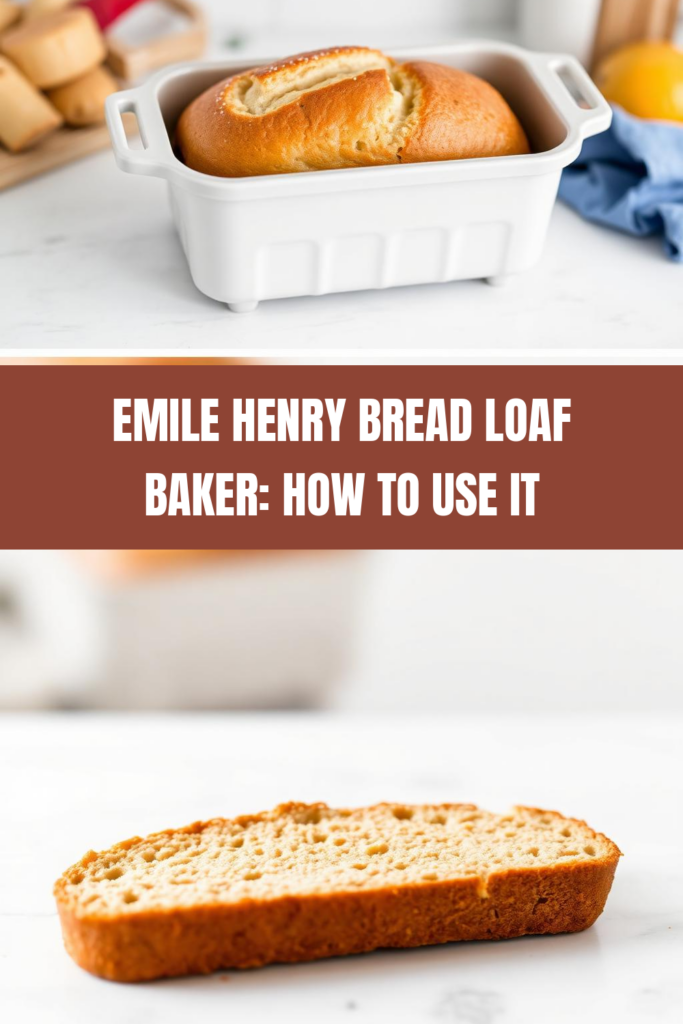
Time: 3 hr 15 min total (about 20 min active) · Serves: 1 loaf (about 12 slices) · The key step: preheat the covered baker empty, then bake with the lid on for steam.
The Emile Henry Bread Loaf Baker is a ceramic lidded pan that traps steam from the dough, giving a crisp crust and open crumb without a Dutch oven. It suits home bakers who want a free-form or shaped loaf with minimal equipment. The baker goes from fridge to oven and cleans up like any ceramic dish.
Why the Covered Baker Makes Better Bread
The covered ceramic pan creates a sealed, steamy environment during the first part of baking. Steam keeps the crust soft while the loaf expands, then removing the lid lets the crust brown and crisp. The baker’s thick walls hold heat, so the bottom and sides cook evenly. Unlike a metal loaf pan, you do not grease it; the dough releases easily once cooled.
Ingredients
- 3 cups (375 g) bread flour, plus more for dusting
- 1 ½ tsp (6 g) instant yeast
- 1 ½ tsp (9 g) fine sea salt
- 1 ½ cups (355 ml) lukewarm water (about 95°F / 35°C)
Optional: 1 tbsp (15 ml) olive oil for a softer crumb, or 1 tbsp (8 g) sesame seeds for topping.
Instructions
- In a large bowl, whisk the flour, yeast, and salt. Add the water and stir with a wooden spoon until a shaggy dough forms. Cover the bowl with plastic wrap or a damp towel and let rest 30 minutes.
- Turn the dough onto a lightly floured surface. Knead for 8–10 minutes, until smooth and elastic. The dough should feel tacky but not sticky; add flour 1 tbsp (8 g) at a time if needed. Place in a lightly oiled bowl, cover, and let rise at room temperature (70–75°F / 21–24°C) for 1 ½ to 2 hours, until doubled.
- Turn the dough out onto a floured surface. Shape it into a log about 9 inches (23 cm) long. Place the log seam-side down on a piece of parchment paper. Cover loosely with plastic wrap and let rise 45 minutes to 1 hour, until puffy but not doubled.
- While the dough rises, place the empty Emile Henry Bread Loaf Baker with its lid on a rack in the center of the oven. Preheat the oven to 450°F (232°C) for at least 30 minutes. The baker must be fully hot before the dough goes in.
- Carefully remove the hot baker from the oven. Lift the parchment with the dough and lower it into the baker. Score the top with a sharp knife or lame, making a ½-inch (1 cm) deep cut lengthwise. Cover with the lid and return to the oven.
- Bake covered for 25 minutes. Remove the lid and bake uncovered for 15–20 minutes more, until the crust is deep golden brown and the internal temperature reads 200–210°F (93–99°C) on an instant-read thermometer. The bread is done when it sounds hollow when tapped on the bottom.
- Transfer the loaf to a wire rack. Cool completely, at least 1 hour, before slicing. The crumb sets as it cools; cutting early makes it gummy.
What Ruins the Crust and Crumb
Opening the oven during the covered phase lets steam escape and can deflate the loaf. Keep the lid on for the full 25 minutes. Skipping the preheat gives a pale, tough crust; the baker must be hot when the dough lands. Overproofing makes a flat loaf: if the dough springs back quickly when poked, it needs more time; if it does not spring back at all, it has gone too far and will collapse. Using all-purpose flour instead of bread flour gives a softer, less chewy crumb but still works. Do not skip the cooling time; a hot loaf tears when sliced.
Storing and Reheating the Loaf
Store the cooled loaf in a paper bag at room temperature for up to 2 days. For longer storage, wrap tightly in plastic wrap and freeze for up to 3 months. To refresh a stale loaf, wrap in foil and heat at 350°F (177°C) for 10 minutes. The ceramic baker should be washed by hand with warm soapy water; avoid thermal shock by letting it cool completely before washing. Do not put the empty baker in a preheated oven without the lid; the lid and base expand together only when both are heated.
Can I Use the Baker Without the Lid?
Yes, but the crust will be thinner and less crisp. If you bake uncovered, reduce the oven to 425°F (218°C) and add a pan of boiling water on the rack below to create steam. Bake 30–35 minutes total, until the internal temperature reaches 200°F (93°C).
How Do I Keep the Loaf From Sticking?
The baker is glazed and does not need greasing. The parchment paper is for easy transfer, not for nonstick. If you skip the parchment, dust the baker lightly with flour or cornmeal before adding the dough. Let the baked loaf cool in the baker for 10 minutes, then lift out with the parchment edges.
Can I Use This for Sourdough?
Yes. Use 100 g active sourdough starter, 350 g bread flour, 230 g water, and 7 g salt. Mix, then perform 4 stretch-and-folds every 30 minutes. Bulk ferment 4–6 hours at room temperature, shape, cold-proof overnight, and bake as directed, adding 5 minutes to the covered time.
Safe minimum internal temperatures follow USDA FSIS; raw-fish guidance follows the U.S. FDA. See our food safety notes.
Spotted an error? Tell us and we will correct it (corrections policy).





