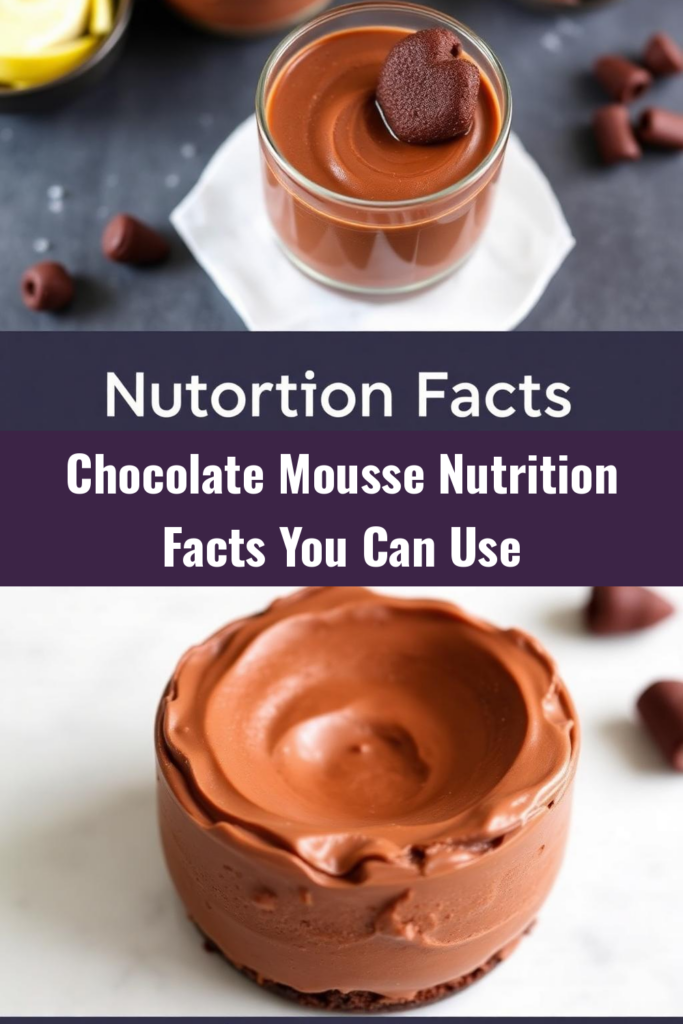
Chocolate mousse is a chilled dessert made by folding whipped cream or beaten egg whites into melted chocolate. Its nutrition depends almost entirely on the chocolate-to-cream ratio and whether eggs are used. The classic French version uses dark chocolate, cream, and eggs; the simpler American version skips eggs and relies on gelatin or extra cream for structure.
Ingredients
- 6 oz (170 g) semisweet or bittersweet chocolate, chopped (about 1 cup chips)
- 1 cup (240 ml) heavy cream, cold, divided
- 3 large egg whites (about 90 g) – pasteurized if you plan to skip cooking
- 2 tbsp (25 g) granulated sugar
- 1/4 tsp salt
- 1 tsp vanilla extract (optional)
Instructions
- Melt the chocolate in a heatproof bowl set over barely simmering water, stirring until smooth. Remove from heat and let cool to 95–100°F (35–38°C), about 5 minutes. If the chocolate is too hot, it will seize when mixed with cream.
- In a separate bowl, beat 3/4 cup (180 ml) of the cold heavy cream to soft peaks. Keep the remaining 1/4 cup (60 ml) for the topping. Refrigerate the whipped cream while you work on the eggs.
- In a clean bowl, beat the egg whites with the salt until foamy. Gradually add the sugar and continue beating to stiff, glossy peaks, about 3–4 minutes. If you are using pasteurized eggs, you can skip the next step.
- If using regular eggs, heat the egg whites and sugar in a heatproof bowl over simmering water, whisking constantly, until the mixture reaches 160°F (71°C) on a food thermometer (about 2 minutes). Then beat to stiff peaks as above. This step kills any bacteria in the raw eggs.
- Fold one-third of the whipped cream into the cooled chocolate to lighten it. Then fold in the remaining whipped cream, followed by the beaten egg whites. Fold gently with a spatula, cutting through the center and turning the bowl, until no streaks remain. Do not overmix or the mousse will deflate.
- Divide the mousse among 4 serving glasses or ramekins. Cover each with plastic wrap and refrigerate for at least 2 hours, until set. The mousse will firm up as it chills.
- Before serving, whip the reserved 1/4 cup (60 ml) cream to soft peaks and spoon a dollop on top. Optionally, grate a little chocolate over each.
What Changes the Nutrition Count
The numbers below are for the recipe as written, using semisweet chocolate and heavy cream. They are approximate; the exact figures depend on the brand of chocolate and cream.
| Component | Amount per serving |
|---|---|
| Calories | about 330 |
| Fat | about 26 g |
| Saturated fat | about 16 g |
| Carbohydrates | about 22 g |
| Protein | about 6 g |
| Sugar | about 18 g |
If you use milk chocolate instead of semisweet, the sugar and calories rise by roughly 15–20%. Dark chocolate (70% cacao) lowers sugar but adds a slightly bitter taste. Replacing half the cream with whole milk cuts fat but makes the mousse less stable and more like a pudding.
Substitutions and How They Change the Result
- Egg whites → aquafaba (chickpea brine): Use 3 tbsp (45 ml) aquafaba for 1 egg white. Whip to stiff peaks; the mousse will be slightly less stable but still airy. This swap makes the dessert egg-free.
- Heavy cream → coconut cream: Use the same volume of chilled coconut cream (from a can, not the light version). The mousse will taste of coconut and set a bit softer.
- Semisweet chocolate → unsweetened plus sugar: Use 4 oz (115 g) unsweetened and add 3 tbsp (40 g) extra sugar. The texture is the same; you control the sweetness.
- Sugar → powdered erythritol: Use the same volume. The mousse will be slightly less sweet and may have a cooling aftertaste.
Why Mousse Turns Out Too Runny, Too Dense, or Too Dry
Too runny
Cause: the chocolate was still warm when folded into the cream, melting the fat and deflating the air. Fix: cool the chocolate to 95–100°F (35–38°C) before folding. Also, whip the cream to soft peaks, not just thick liquid. If the mousse is already runny, refrigerate for 30 minutes longer; if it still won’t set, fold in 1/2 cup (120 ml) of extra whipped cream to stiffen.
Too dense
Cause: overmixing after adding the egg whites, or using chocolate that was too thick (e.g., 85% cacao). Fix: fold only until no streaks remain. For very dark chocolate, add 1 tbsp (15 ml) of warm water to the melted chocolate to thin it before folding.
Too dry or grainy
Cause: the egg whites were overbeaten until they broke, or the chocolate seized from steam or water. Fix: beat egg whites only to stiff peaks, not until they look curdled. When melting chocolate, keep water out of the bowl. If the mousse is grainy, you can’t fix it after the fact; start over with fresh chocolate.
Storing Chocolate Mousse
Refrigerate the mousse in covered containers. It keeps for 3–4 days. The texture is best within 24 hours; after that, it may weep slightly. Do not freeze mousse with whipped cream or egg whites – freezing ruins the airy structure and turns it watery. If you must freeze, make the egg-free version (use gelatin or extra cream) and freeze for up to 2 weeks, then thaw overnight in the fridge.
Raw egg whites: if you choose not to heat them, use pasteurized eggs and keep the mousse refrigerated. Pregnant people, young children, older adults, and anyone with a weakened immune system should avoid raw eggs. Raw flour is not used in this recipe.
To check if the mousse is set, insert a spoon: it should hold a soft shape and not run. If it’s still liquid after 2 hours, it may need more chilling – up to 4 hours total.
Related
- Banana Bread Loaf Calories and Nutrition Facts
- Coconut Milk Chia Pudding Nutrition Facts
- Banana Bread Chocolate Loaf Recipe
Safe minimum internal temperatures follow USDA FSIS; raw-fish guidance follows the U.S. FDA. See our food safety notes.
Spotted an error? Tell us and we will correct it (corrections policy).