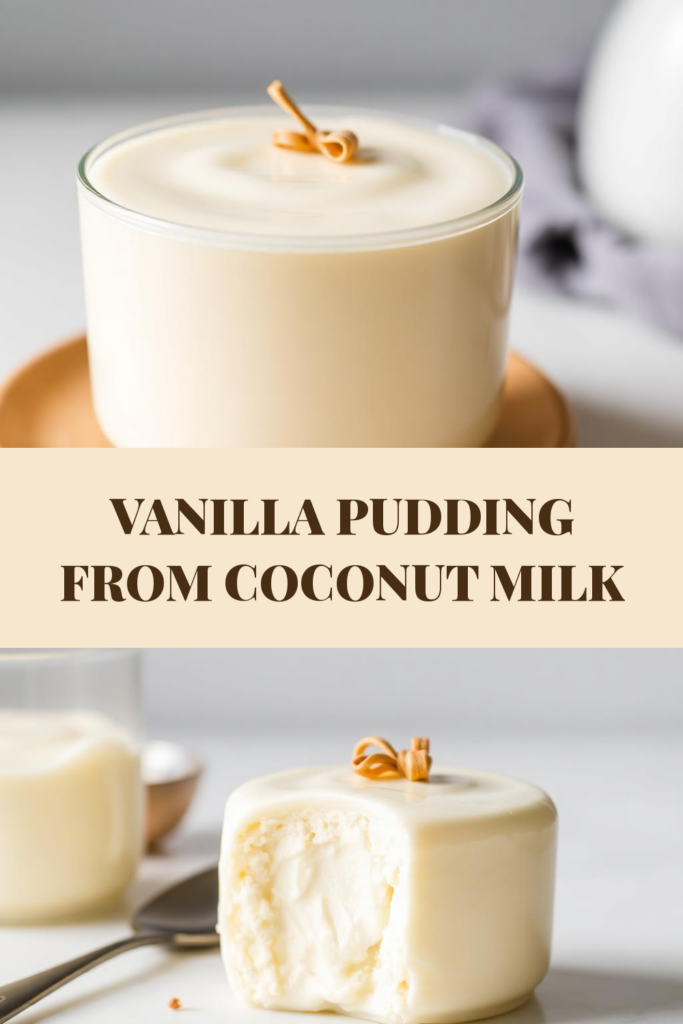
This coconut milk vanilla pudding sets into a silky, spoonable custard with a light coconut flavor and none of the dairy. Cooking the starch fully and chilling it long enough gives the smooth, firm-yet-creamy texture you expect from pudding, while the coconut milk adds richness without needing cream.
Ingredients
- 2 cups (480 ml) full-fat coconut milk (from a can, not a carton)
- 1/2 cup (100 g) granulated sugar
- 3 tbsp (24 g) cornstarch
- 1/4 tsp salt
- 2 large egg yolks
- 2 tsp vanilla extract
Instructions
- In a medium bowl, whisk the egg yolks with 1/4 cup (60 ml) of the coconut milk until smooth. Set aside.
- In a medium saucepan, whisk together the sugar, cornstarch, and salt. Gradually whisk in the remaining 1 3/4 cups (420 ml) coconut milk until no lumps remain.
- Place the saucepan over medium heat. Cook, stirring constantly with a whisk, until the mixture thickens and comes to a gentle boil, about 8–10 minutes. Once it bubbles, cook for 1 full minute more, stirring, to eliminate the raw cornstarch taste.
- Remove from heat. Slowly pour about 1/2 cup of the hot coconut mixture into the egg yolk mixture, whisking constantly to temper the yolks. Then pour the yolk mixture back into the saucepan, whisking continuously.
- Return the saucepan to medium-low heat. Cook, stirring constantly, for 2–3 minutes, until the pudding is thick and just begins to bubble. It should coat the back of a spoon.
- Remove from heat and stir in the vanilla extract.
- Pour the pudding through a fine-mesh strainer into a bowl to remove any cooked egg bits. Divide among 4 small cups or ramekins.
- Press plastic wrap directly onto the surface of each pudding to prevent a skin from forming. Refrigerate for at least 3 hours, until fully chilled and set. Serve cold.
How Long Does Coconut Milk Pudding Keep?
Refrigerate the pudding within 2 hours of making it. It will keep for 3–4 days in the fridge, covered with plastic wrap or in an airtight container. Do not freeze—coconut milk pudding separates and turns grainy when thawed. If you see any sour smell or visible mold, discard it. Always reheat leftovers? No, this pudding is served cold; if you prefer warm pudding, eat it right after cooking (but it will be thinner).
Scaling for Half and Double Batches
| Batch | Coconut milk | Sugar | Cornstarch | Egg yolks | Servings |
|---|---|---|---|---|---|
| Half | 1 cup (240 ml) | 1/4 cup (50 g) | 1 1/2 tbsp (12 g) | 1 | 2 |
| Full | 2 cups (480 ml) | 1/2 cup (100 g) | 3 tbsp (24 g) | 2 | 4 |
| Double | 4 cups (960 ml) | 1 cup (200 g) | 6 tbsp (48 g) | 4 | 8 |
For a half batch, use a smaller saucepan and reduce the cooking time by about 2 minutes. For a double batch, use a large pot and expect the thickening time to be closer to 12–15 minutes.
Serving and Pairing Ideas
Serve the pudding plain, or top it with toasted coconut flakes, a sprinkle of cinnamon, or fresh berries. It pairs well with shortbread cookies or a slice of pound cake. For a tropical twist, layer it with diced mango and crushed pineapple in a glass. If you want a richer pudding, use 1 cup (240 ml) coconut milk and 1 cup (240 ml) heavy cream instead of all coconut milk—this will make it thicker and more traditional, but the coconut flavor will be milder.
Why Did My Pudding Turn Out Lumpy or Thin?
Lumps usually come from adding the egg yolks too quickly or not whisking constantly during cooking. To fix a lumpy pudding, press it through a fine-mesh strainer after cooking—this removes most lumps. Thin pudding means the cornstarch wasn’t cooked long enough; it must reach a full boil and boil for 1 minute to activate fully. If your pudding is still thin after chilling, it may have been undercooked. For a gluten-free check, cornstarch is naturally gluten-free, but always read the label to confirm.
Can I Use Light Coconut Milk or a Carton?
Light coconut milk makes a thinner pudding that may not set as firmly; if you use it, reduce the coconut milk to 1 3/4 cups (420 ml) and increase the cornstarch to 4 tbsp (32 g). Coconut milk from a carton (the kind meant for drinking) is too watery and will not set properly—stick with canned full-fat coconut milk for the best texture. For a dairy-free version, this recipe is already dairy-free; ensure your vanilla extract is alcohol-free if that matters to you.
Raw Egg Warning
This recipe uses egg yolks that are cooked to at least 160°F (71°C) during the final simmer, which is the USDA FSIS safe minimum for egg dishes. However, if you are serving pregnant people, young children, older adults, or anyone with a weakened immune system, use pasteurized eggs to eliminate any risk of foodborne illness. Do not taste the pudding before it has reached a full boil.
Safe minimum internal temperatures follow USDA FSIS; raw-fish guidance follows the U.S. FDA. See our food safety notes.
Spotted an error? Tell us and we will correct it (corrections policy).