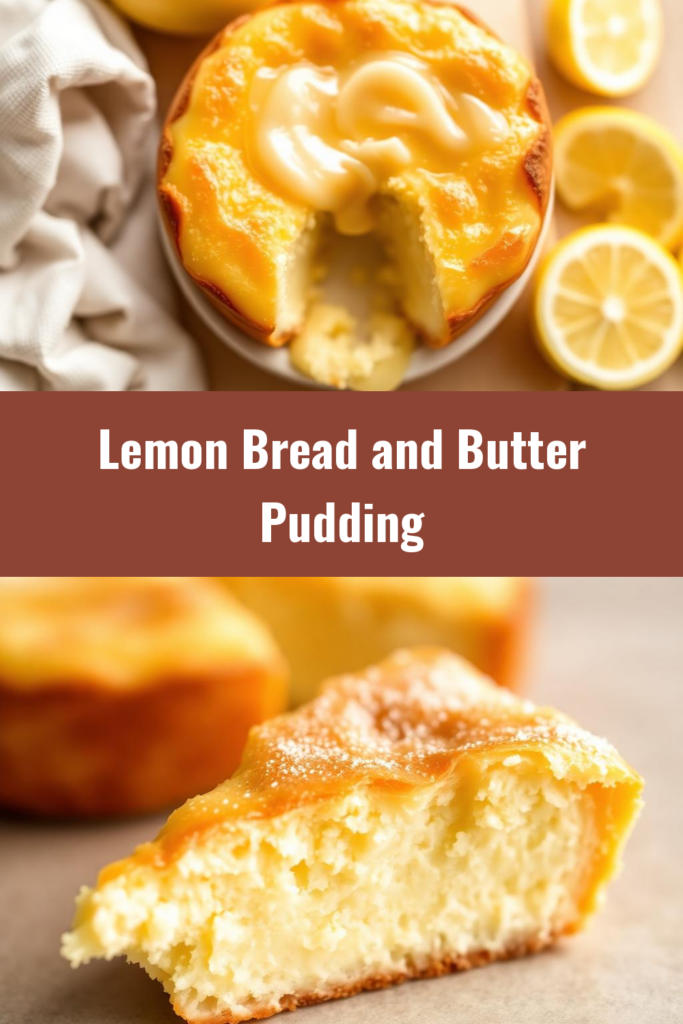
Time: 25 min prep · 40-45 min bake · Serves: 8 · The key step: soak the bread in the custard for at least 20 minutes before baking so the center sets like a soft, lemony custard.
Lemon bread and butter pudding takes the classic British dessert—buttered bread layered with a sweet egg custard—and adds lemon zest, lemon juice, and a sugar crust. The result is a warm, tangy, creamy bake with a crisp top and soft, pudding-like center. It works as a weeknight dessert, a brunch centerpiece, or a make-ahead dish for a holiday table.
What This Pudding Needs
This recipe uses day-old white bread (brioche, challah, or sourdough all work) and a simple stovetop custard. The lemon comes from both zest and juice—zest for aroma, juice for tartness. If you use a sweeter bread like brioche, reduce the sugar by 1 tablespoon; if you use sourdough, keep the full amount.
For a less tangy pudding, use only 2 tablespoons of lemon juice. For a more intense lemon flavor, add 1 teaspoon of lemon extract (not lemon oil) along with the zest. Do not use bottled lemon juice; fresh juice has a brighter, cleaner flavor.
Ingredients
- 8 cups (about 400 g) day-old white bread, crusts on, cut into 1-inch cubes
- 4 tbsp (56 g) unsalted butter, softened, plus extra for greasing
- 2 cups (480 ml) whole milk
- 1 cup (240 ml) heavy cream
- 3/4 cup (150 g) granulated sugar, divided
- 1 tbsp (6 g) lemon zest (from about 2 large lemons)
- 1/4 cup (60 ml) fresh lemon juice (from about 1 large lemon)
- 4 large eggs
- 1 tsp vanilla extract
- 1/4 tsp salt
- 2 tbsp (25 g) coarse sugar (turbinado or demerara) for topping
Instructions
- Grease a 9×13-inch (23×33 cm) baking dish with butter. Spread the bread cubes on a baking sheet and let them dry out for 30 minutes if they are fresh, or skip if already stale.
- In a medium saucepan over medium heat, combine the milk, cream, 1/2 cup (100 g) of the granulated sugar, lemon zest, and salt. Heat, stirring occasionally, until the sugar dissolves and the mixture is steaming but not boiling, about 5 minutes. Remove from heat and let cool for 5 minutes.
- In a large bowl, whisk the eggs, remaining 1/4 cup (50 g) granulated sugar, lemon juice, and vanilla until smooth. Slowly pour the warm milk mixture into the egg mixture, whisking constantly to prevent curdling. Strain the custard through a fine-mesh sieve into a large measuring cup or bowl.
- Place the bread cubes in the prepared dish. Pour the custard over the bread, pressing the bread down gently with a spatula so it soaks evenly. Let sit at room temperature for 20 minutes, pressing down occasionally, until the bread absorbs most of the liquid.
- Preheat the oven to 350°F (175°C). Sprinkle the top with the coarse sugar.
- Bake for 40-45 minutes, until the pudding is puffed and golden, and the center is just set—it should jiggle slightly when shaken, not ripple like liquid. A knife inserted 1 inch from the center should come out mostly clean, with a few moist crumbs. The internal temperature of the custard should reach 160°F (71°C), the USDA FSIS safe minimum for egg dishes.
- Let cool on a wire rack for 10 minutes before serving. Serve warm or at room temperature.
Doneness Cues and Troubleshooting
How to tell it’s done: The top should be deep golden and slightly cracked, the edges bubbling, and the center should feel firm but springy when pressed lightly. A knife inserted near the center should come out with just a few moist crumbs, not wet custard. If the top browns too quickly, cover loosely with foil for the last 10 minutes.
Mistake 1: Overbaking. Baking longer than 50 minutes dries out the custard and makes the bread rubbery. The pudding will continue to set as it cools, so pull it out when the center still has a slight jiggle.
Mistake 2: Under-soaking the bread. If you skip the 20-minute soak, the bread stays dry in the center and the custard pools at the bottom. Press the bread down a few times during the soak to ensure even absorption.
Mistake 3: Curdling the custard. Pouring hot milk directly into eggs scrambles them. Always temper by adding the milk slowly while whisking, and strain the mixture to catch any bits.
Make-Ahead and Storage
Assemble the pudding (through step 4) up to 24 hours ahead, cover with plastic wrap, and refrigerate. Add 5-10 minutes to the baking time since the dish starts cold. The pudding can also be baked fully, cooled, and refrigerated for up to 3 days.
To reheat, cover with foil and warm in a 300°F (150°C) oven for 15-20 minutes, or microwave individual portions for 30-45 seconds. The crisp sugar topping will soften on reheating; you can sprinkle a little fresh sugar on top before serving.
Freeze the baked, cooled pudding in an airtight container for up to 2 months. Thaw overnight in the refrigerator and reheat as above. Do not freeze unbaked pudding—the custard separates.
Variations and Swaps
Bread: Brioche or challah make a richer pudding; sourdough adds a slight tang. Gluten-free bread works, but may absorb less liquid—reduce the custard by 1/4 cup (60 ml) and check after 15 minutes of soaking.
Dairy-free: Use full-fat oat milk or coconut milk (not coconut beverage) and a plant-based butter. The pudding will be slightly less creamy but still set.
Extra lemon: Add 1 tablespoon of lemon curd dolloped on top before baking for a stronger lemon layer. Or serve with a spoonful of lemon curd on the side.
Less sweet: Reduce the total sugar to 1/2 cup (100 g) and skip the coarse sugar topping—the lemon will be more prominent.
Add-ins: Fold in 1/2 cup (60 g) dried blueberries or 1/2 cup (75 g) white chocolate chips before baking; both work well with lemon.
Egg safety: This recipe uses raw eggs in the custard before baking. The pudding is baked to 160°F (71°C), which kills any bacteria. If you prefer to use pasteurized eggs, they are safe to use raw in the custard, but baking is still required for the dish to set.
Flour note: The bread is baked, so no raw flour risk. If you use a flour-based topping (like a crumble), heat-treat the flour to 160°F (71°C) first.
Safe minimum internal temperatures follow USDA FSIS; raw-fish guidance follows the U.S. FDA. See our food safety notes.
Spotted an error? Tell us and we will correct it (corrections policy).





