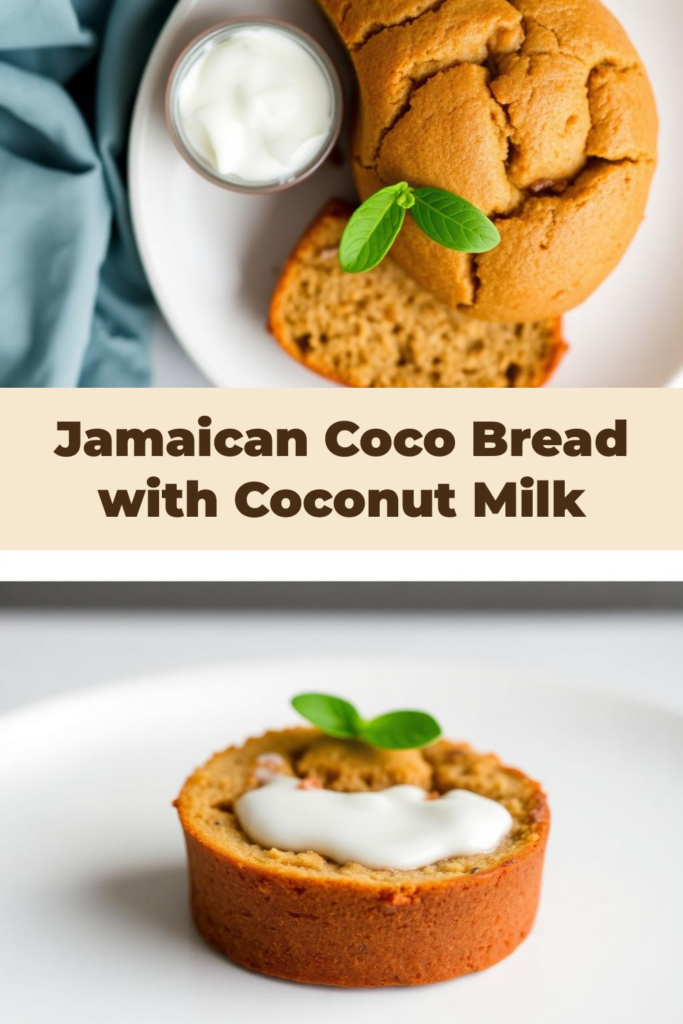
Jamaican coco bread is a soft, slightly sweet flatbread made with coconut milk, traditionally split and filled with a spicy patty. This version uses coconut milk in the dough for a tender crumb and a gentle tropical flavor, and it comes together in about 2 hours including rise time. The key is a warm, slack dough that bakes into a pillowy pocket, not a crisp flatbread.
What Equipment Matters
You need a large mixing bowl, a rolling pin, and a baking sheet. A stand mixer with a dough hook makes kneading easier, but you can knead by hand on a lightly floured surface for 10 minutes. Use a kitchen scale for the flour if you have one—measuring by volume can add or remove 20–30 g and change the dough’s texture. A bench scraper helps divide the dough evenly. No special pan is required; the breads bake directly on a parchment-lined sheet.
Ingredients
- 4 cups (500 g) all-purpose flour, plus more for dusting
- 1/4 cup (50 g) granulated sugar
- 1 packet (2 1/4 tsp / 7 g) instant yeast
- 1 tsp salt
- 1 cup (240 ml) coconut milk (full-fat, canned or carton)
- 1/2 cup (120 ml) warm water (about 110°F / 43°C)
- 3 tbsp (45 g) unsalted butter, melted, plus 2 tbsp (30 g) for brushing
Use full-fat coconut milk for the softest crumb; light coconut milk makes a drier bread. If you only have coconut cream, thin it with water to reach 1 cup (240 ml) total liquid.
How to Make Jamaican Coco Bread
- In a small bowl, stir the warm water and yeast together. Let stand 5 minutes until foamy. If it does not foam, the yeast is dead—start over with fresh yeast.
- In a large bowl, whisk the flour, sugar, and salt. Add the coconut milk, yeast mixture, and 3 tbsp melted butter. Stir with a wooden spoon until a shaggy dough forms.
- Turn the dough onto a lightly floured surface. Knead for 8–10 minutes (or 5–6 minutes in a stand mixer on medium speed) until smooth and elastic. The dough will be slightly sticky; add flour only if it sticks to your hands excessively.
- Place the dough in a lightly oiled bowl, cover with plastic wrap or a damp towel, and let rise in a warm spot (about 75–80°F / 24–27°C) for 1 hour, or until doubled in size.
- Punch down the dough. Divide it into 8 equal pieces (about 110 g each). Roll each piece into a ball, cover with a towel, and let rest 10 minutes.
- Preheat the oven to 375°F (190°C). Line a baking sheet with parchment paper.
- Roll one ball into a 6-inch (15 cm) round, about 1/4 inch (6 mm) thick. Brush the surface lightly with melted butter, then fold it in half to make a half-moon. Press the edges gently to seal, but do not crimp—the bread will puff open slightly during baking, which is traditional. Place on the prepared sheet. Repeat with the remaining dough, spacing the breads 2 inches (5 cm) apart.
- Cover the shaped breads with a towel and let rise 20 minutes. They will puff slightly.
- Bake for 15–18 minutes, until golden brown on top and the bottoms sound hollow when tapped. The internal temperature should read 190–200°F (88–93°C) if you want to check—this is a bread, not a meat dish, so no USDA safe minimum applies, but it must be fully baked through.
- Remove from the oven and brush immediately with the remaining 2 tbsp melted butter. Cool on a wire rack for 10 minutes before serving warm.
Batch Sizes and Scaling
This recipe makes 8 breads. To make 4, halve all ingredients; to make 16, double them. The rise times stay the same. For a smaller batch, use 2 cups (250 g) flour, 2 tbsp (25 g) sugar, 1/2 tsp salt, 1/2 cup (120 ml) coconut milk, 1/4 cup (60 ml) water, 1 1/2 tsp yeast, and 1 1/2 tbsp butter in the dough, plus 1 tbsp for brushing. For a larger batch, use 8 cups (1 kg) flour, 1/2 cup (100 g) sugar, 2 tsp salt, 2 cups (480 ml) coconut milk, 1 cup (240 ml) water, 2 packets (4 1/2 tsp / 14 g) yeast, and 6 tbsp (90 g) butter in the dough, plus 4 tbsp for brushing.
What Goes Wrong and How to Fix It
Dough too dry and crumbly: This happens when you add too much flour during kneading. The dough should be soft and slightly tacky. If it cracks when rolled, mist it with water and knead 1 minute more.
Bread bakes flat and dense: The dough was not risen enough. The first rise must double in volume; if your kitchen is cool, extend the time to 1 1/2 hours. Also, do not skip the 20-minute rest after shaping—it lets the gluten relax so the bread puffs.
Bread splits open too much: You sealed the edges too tightly. Leave a small gap in the fold, or do not press the edges at all—just lay the folded dough on the sheet. The steam needs an escape.
How Long Does Coco Bread Keep?
Store cooled breads in an airtight container at room temperature for up to 2 days. They are best eaten the same day. For longer storage, wrap each bread individually in plastic wrap, place in a freezer bag, and freeze for up to 3 months. Thaw at room temperature for 1 hour, then reheat in a 350°F (175°C) oven for 5–7 minutes until warm and soft. Do not microwave—it makes the bread rubbery. If you have filled the bread with a patty, refrigerate the filled bread and eat within 2 days, reheating to 165°F (74°C) for leftovers.
What to Serve with Coco Bread
Split the warm bread open and fill it with a spicy beef or vegetable patty, or serve it alongside jerk chicken, curry goat, or a bowl of pumpkin soup. It also works as a breakfast bread with butter and jam. The bread is neutral enough to pair with any savory filling; the coconut milk adds richness but not sweetness.
Can I Make the Dough Ahead?
Yes. After the first rise, punch down the dough, wrap it tightly in plastic, and refrigerate for up to 24 hours. When ready to bake, let it sit at room temperature for 30 minutes, then proceed with shaping. The cold dough will need an extra 10–15 minutes for the final rise. You can also freeze the shaped, unbaked breads on a sheet until solid, then transfer to a bag and freeze for up to 1 month. Bake from frozen at 375°F (190°C) for 20–22 minutes, adding 3–4 minutes to the time.
Why Use Coconut Milk Instead of Water?
Coconut milk adds fat and natural sugars, which make the crumb softer and the crust slightly golden. It also gives a mild coconut flavor that is not overpowering. If you substitute water, the bread will be chewier and less rich. For a dairy-free version, use coconut oil instead of butter in the dough and for brushing; the texture will be slightly more tender.
Safe minimum internal temperatures follow USDA FSIS; raw-fish guidance follows the U.S. FDA. See our food safety notes.
Spotted an error? Tell us and we will correct it (corrections policy).





