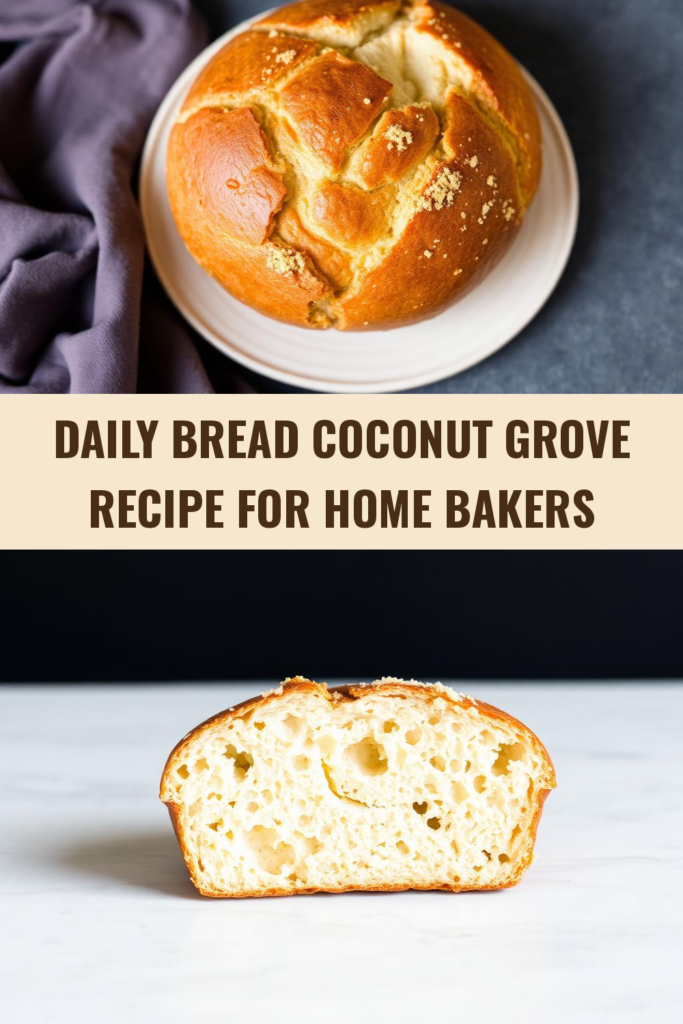
Daily Bread Coconut Grove is a soft, lightly sweet yeast bread with a tender crumb and a toasted coconut crust. The dough relies on a tangzhong (flour-and-water roux) to hold moisture, which keeps the loaf tender for days. It suits breakfast, brunch, or an afternoon snack with coffee.
Ingredients
- Tangzhong: 3 tbsp (45 ml) water, 3 tbsp (45 ml) whole milk, 2 tbsp (16 g) bread flour
- Dough: 3 cups (375 g) bread flour, 1/4 cup (50 g) granulated sugar, 2 1/4 tsp (7 g) instant yeast, 1 tsp (5 g) fine salt, 1/2 cup (120 ml) whole milk, lukewarm (100–110°F / 38–43°C), 1 large egg, room temperature, 4 tbsp (57 g) unsalted butter, softened, 1 tsp (5 ml) vanilla extract
- Topping: 1 cup (85 g) sweetened shredded coconut, 2 tbsp (30 g) unsalted butter, melted, 2 tbsp (30 ml) honey
- Egg wash: 1 large egg beaten with 1 tbsp (15 ml) water
Make the Tangzhong
- In a small saucepan, whisk the water, milk, and bread flour until smooth.
- Cook over medium heat, stirring constantly, until the mixture thickens to a paste and reaches 150°F (65°C), about 2–3 minutes. Remove from heat and let cool to room temperature.
Mix and Knead the Dough
- In a stand mixer bowl, combine the bread flour, sugar, yeast, and salt. Add the tangzhong, lukewarm milk, egg, softened butter, and vanilla.
- Mix on low speed until a shaggy dough forms, about 2 minutes. Increase to medium speed and knead for 8–10 minutes, until the dough is smooth, elastic, and passes the windowpane test (a thin piece stretches without tearing).
- Shape the dough into a ball and place in a lightly oiled bowl. Cover with plastic wrap and let rise in a warm spot (75–80°F / 24–27°C) until doubled, about 1 hour.
Shape and Second Rise
- Turn the dough onto a lightly floured surface. Press into a 10×8-inch (25×20 cm) rectangle.
- Roll tightly from the short side into a log, pinching the seam. Place seam-side down in a greased 9×5-inch (23×13 cm) loaf pan.
- Cover loosely with plastic wrap and let rise until the dough crests about 1 inch (2.5 cm) above the pan rim, about 45–60 minutes.
Add Coconut Topping
- Preheat the oven to 350°F (177°C).
- In a small bowl, mix the shredded coconut, melted butter, and honey until the coconut is evenly coated.
- Brush the risen loaf with the egg wash. Gently press the coconut mixture onto the top and sides of the dough.
Bake and Cool
- Bake the loaf at 350°F (177°C) for 35–40 minutes, until the internal temperature reaches 190°F (88°C) and the top is deep golden brown. If the coconut browns too quickly, tent loosely with foil after 20 minutes.
- Remove from the oven and let cool in the pan for 10 minutes. Transfer to a wire rack and cool completely, about 1 hour, before slicing.
Serve and Pair
Slice thick and serve warm or toasted. The bread pairs well with butter and jam, or with a smear of cream cheese. It also makes excellent French toast: dip slices in a mixture of beaten egg, milk, and cinnamon, then cook on a griddle at 350°F (177°C) for 2–3 minutes per side until golden and cooked through (egg dish safe minimum 160°F / 71°C).
Variations to Try
- Citrus Coconut: Add 1 tbsp (15 ml) lemon zest and 1 tsp (5 ml) lemon extract to the dough with the vanilla. Replace the honey in the topping with maple syrup.
- Almond-Coconut: Substitute 1/2 cup (60 g) of the bread flour with 1/2 cup (50 g) almond flour. Add 1/2 tsp (2 g) almond extract to the dough. The loaf will be slightly denser.
Storing and Freezing
Store the loaf wrapped in plastic wrap at room temperature for up to 3 days. For longer storage, wrap tightly and freeze for up to 2 months. Thaw overnight in the refrigerator, then reheat slices in a toaster or oven at 300°F (149°C) for 5–7 minutes. Do not leave the bread out for more than 2 hours in warm conditions; if the coconut topping contains honey, it is safe at room temperature for 3 days, but refrigerate if your kitchen is above 80°F (27°C).
Why Tangzhong Works
The tangzhong gelatinises the flour’s starch, which traps water in the dough. This extra moisture makes the crumb softer and slows staling. Without it, the bread will be drier by the second day. If you skip it, increase the milk by 2 tbsp (30 ml) and expect a denser loaf.
Checking Doneness
Use an instant-read thermometer inserted into the center of the loaf; it should read 190°F (88°C). The top should be firm and the coconut should smell toasted. If the thermometer reads lower, return the loaf to the oven for 5 more minutes and check again.
Common Questions
Can I use all-purpose flour? Yes, but the crumb will be slightly less chewy. Use the same weight (375 g) and expect a softer, less structured loaf.
Why did my coconut burn? The topping is exposed to direct heat. If your oven runs hot, start checking at 30 minutes, and cover the top with foil as soon as it reaches a deep golden brown.
Can I make this without a stand mixer? Yes, knead by hand on a lightly floured surface for 12–15 minutes until smooth and elastic. The dough will be slightly sticky at first; resist adding more flour.
Safe minimum internal temperatures follow USDA FSIS; raw-fish guidance follows the U.S. FDA. See our food safety notes.
Spotted an error? Tell us and we will correct it (corrections policy).





