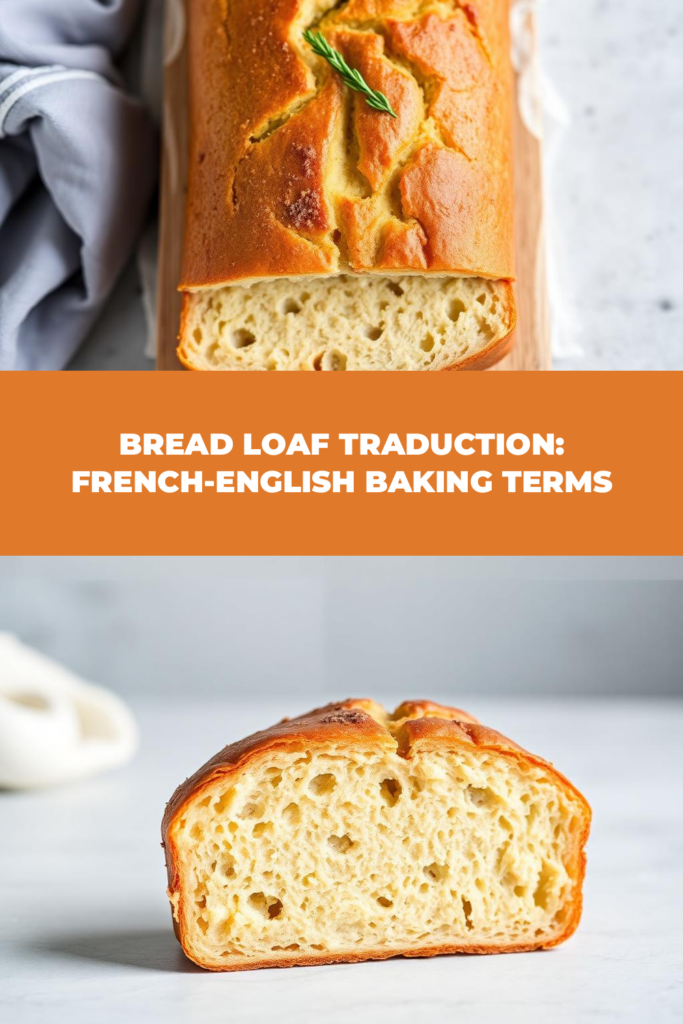
In French, “bread loaf” is pain de mie (a sandwich loaf) or simply une miche (a round country loaf). The word “traduction” means translation, so this page translates the baking terms you’ll need when following a French bread recipe or converting an American one.
Key French Bread Words
Here are the most common terms you’ll see in a French bread recipe, with the English equivalent and what it means in practice.
| French | English | Meaning |
|---|---|---|
| pain | bread | General term for bread |
| pain de mie | sandwich loaf / pullman loaf | A soft, square-sided loaf for toast and sandwiches |
| miche | round loaf / country loaf | A rustic, round bread, often with a thick crust |
| baguette | baguette | A long, thin loaf with a crisp crust |
| farine | flour | Usually wheat flour unless specified |
| levure | yeast | Usually active dry or fresh yeast |
| levain | sourdough starter | Fermented flour-water mixture for leavening |
| pâte | dough | The mixed, unbaked dough |
| pétrir | to knead | Working the dough to develop gluten |
| pousse | rise / proof | The dough’s fermentation period |
| four | oven | Baking appliance |
| cuire | to bake | Cooking in the oven |
| croûte | crust | The outer layer of the loaf |
| mie | crumb | The soft interior of the loaf |
| tranche | slice | A cut piece of bread |
Translating a French Recipe
When you encounter a French bread recipe, translate the ingredient list first, then the method. Here’s a typical French ingredient list with conversions.
Example: “500 g de farine, 10 g de sel, 5 g de levure, 350 ml d’eau” means 500 g flour, 10 g salt, 5 g yeast, 350 ml water. That’s about 4 cups (500 g) all-purpose flour, 2 tsp (10 g) salt, 1½ tsp (5 g) active dry yeast, and 1½ cups (350 ml) water.
French recipes almost always use grams and milliliters, so a kitchen scale is the most accurate tool. If you only have cups, use the conversions below, but note that cup measures can vary by how you scoop.
Common Measurement Conversions
Use these for bread baking. Weighing is more reliable than volume.
| French (metric) | US volume | Weight |
|---|---|---|
| 1 cup (240 ml) | 1 cup | — |
| 1 tbsp (15 ml) | 1 tbsp | — |
| 1 tsp (5 ml) | 1 tsp | — |
| 100 g flour | ¾ cup + 1 tbsp | 100 g |
| 250 g flour | 2 cups | 250 g |
| 500 g flour | 4 cups | 500 g |
| 5 g yeast | 1½ tsp active dry | 5 g |
| 10 g salt | 2 tsp | 10 g |
For water, 1 cup = 240 ml, so 350 ml is about 1½ cups. For milk, same conversion. For butter, 1 stick = 113 g = 8 tbsp.
French Bread Terms in Method Steps
French recipes often use these verbs and phrases. Knowing them lets you follow the method without a full translation.
- Mélanger – to mix. Combine dry and wet ingredients.
- Pétrir – to knead. Work the dough until smooth and elastic, about 8–10 minutes by hand.
- Laisser lever – to let rise. Cover and let the dough double in volume, typically 1–2 hours at room temperature (70–75°F / 21–24°C).
- Dégazer – to punch down. Press out the air after the first rise.
- Façonner – to shape. Form the dough into a loaf or round.
- Apprêt – second rise. Usually 30–60 minutes after shaping.
- Enfourner – to put in the oven. Bake at the specified temperature.
- Laisser refroidir – to cool. Cool completely on a wire rack before slicing.
Baking a Basic Pain de Mie
If you want to bake the loaf itself, here’s a straightforward recipe for a soft sandwich bread, which is what “bread loaf” usually means in French.
Ingredients
- 4 cups (500 g) all-purpose flour
- 2 tsp (10 g) salt
- 1½ tsp (5 g) active dry yeast
- 1½ cups (350 ml) warm water (105–115°F / 40–46°C)
- 2 tbsp (30 g) unsalted butter, softened
- 1 tbsp (15 g) sugar (optional, for a slightly sweet loaf)
Instructions
- In a large bowl, whisk the flour and salt. In a small bowl, dissolve the yeast in the warm water with the sugar (if using) and let stand 5 minutes until foamy.
- Add the yeast mixture and softened butter to the flour. Mix with a wooden spoon until a shaggy dough forms.
- Turn the dough onto a floured surface and knead for 8–10 minutes, until smooth and elastic. If using a stand mixer, knead with the dough hook on medium speed for 6–8 minutes.
- Place the dough in a lightly oiled bowl, cover with plastic wrap or a damp towel, and let rise in a warm spot (about 75°F / 24°C) for 1½–2 hours, until doubled in size.
- Punch down the dough. Shape into a rectangle and roll it into a log. Place the log in a greased 9×5-inch (23×13 cm) loaf pan.
- Cover and let rise again for 45–60 minutes, until the dough rises just above the rim of the pan.
- Preheat the oven to 375°F (190°C). Bake for 30–35 minutes, until the top is deep golden and the loaf sounds hollow when tapped on the bottom. The internal temperature should read 200–210°F (93–99°C) for a fully baked loaf.
- Remove from the pan immediately and cool completely on a wire rack, at least 1 hour, before slicing.
Storing and Freezing the Loaf
Store the cooled loaf in a plastic bag or bread box at room temperature for up to 3 days. Do not refrigerate, as that dries the crumb faster. For longer storage, slice the bread, wrap tightly in plastic wrap and then foil, and freeze for up to 3 months. Thaw slices at room temperature or toast directly from frozen.
Translating Other Baking Terms
Beyond bread, these terms appear in many French baking recipes. Keep this list handy.
- Beurre – butter
- Œufs – eggs
- Lait – milk
- Sucre – sugar
- Sel – salt
- Eau – water
- Huile – oil
- Miel – honey
- Fourchette – fork (used for mixing)
- Rouleau à pâtisserie – rolling pin
- Plat – baking dish
- Grille – cooling rack
Checking a Translation’s Accuracy
If you’re unsure about a term, look for the context in the recipe. For example, “farine de blé” is wheat flour, while “farine complète” is whole wheat flour. “Levure chimique” is baking powder, not yeast. “Levure boulangère” is baker’s yeast. When a recipe says “four préchauffé à 180°C”, that’s 350°F. For a quick conversion, double the Celsius and add 30 for Fahrenheit (180°C → 360°F, close enough). For exact, use the formula F = C × 9/5 + 32.
If you’re translating a recipe from a French website, many have a language toggle or a comment section where bakers discuss conversions. When in doubt, weigh your ingredients in grams—that’s the most reliable way to match the original recipe.
Safe minimum internal temperatures follow USDA FSIS; raw-fish guidance follows the U.S. FDA. See our food safety notes.
Spotted an error? Tell us and we will correct it (corrections policy).