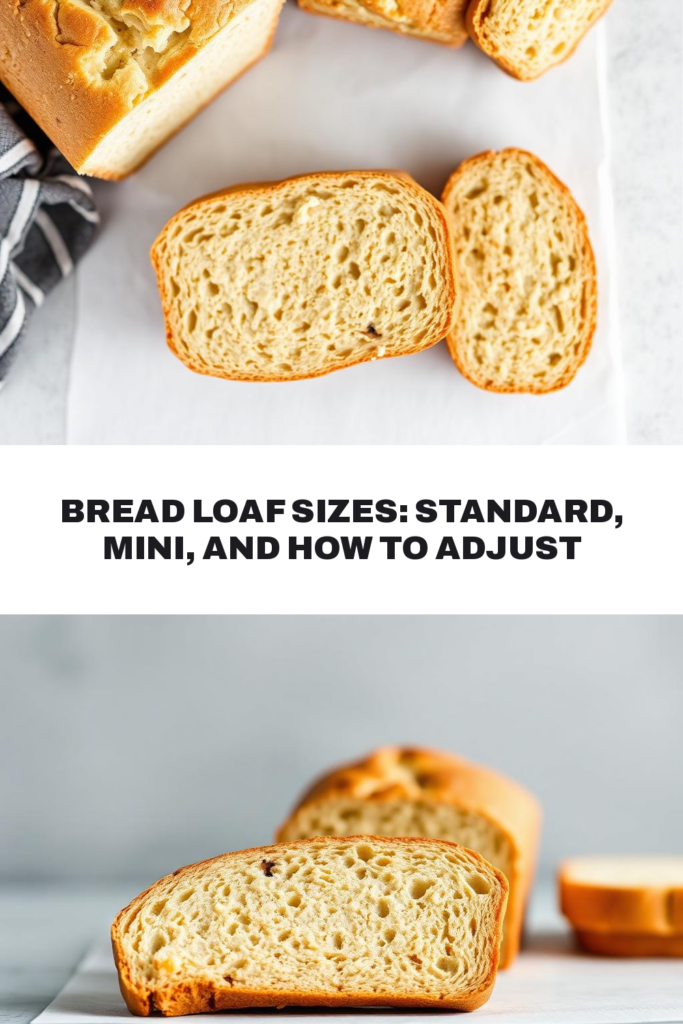
Time: Varies by size · Serves: 1 loaf (8–12 slices) · The key step: Match pan volume to dough weight. Bread loaf sizes are defined by the pan you bake in and the amount of dough you use. A standard 9×5-inch loaf pan holds about 8 cups (1.9 L) and produces a loaf that slices into 10–12 pieces, while mini pans make 4–6 slices. This page covers the common sizes, how much dough each needs, and how to adjust any bread recipe for a different pan.
Standard Loaf Pan Sizes
Most home recipes call for one of two loaf pans:
| Pan Size (inches) | Volume | Typical Dough Weight | Slices |
|---|---|---|---|
| 9×5×3 | 8 cups (1.9 L) | 1.5–2 lb (680–900 g) | 10–12 |
| 8.5×4.5×2.5 | 6 cups (1.4 L) | 1–1.5 lb (450–680 g) | 8–10 |
| Mini (5.75×3.25×2) | 2 cups (475 ml) | 0.5–0.75 lb (225–340 g) | 4–6 |
Measure your pan across the top from inside edge to inside edge. If you do not know the volume, fill it with water one cup at a time; the number of cups is the volume.
How Much Dough Per Pan
A general rule: use about 1.5 times the pan volume in ounces of dough. For a 9×5 pan (8 cups), that is 12 oz (340 g) of dough for a short loaf, up to 24 oz (680 g) for a full loaf. Most sandwich bread recipes yield 1.5–2 lb (680–900 g) of dough, which fits a 9×5 pan perfectly.
If your recipe does not give a dough weight, weigh the total dough after mixing and divide by the number of loaves you want. For a 9×5 pan, aim for 1.5–2 lb (680–900 g). For an 8.5×4.5 pan, use 1–1.5 lb (450–680 g). For mini pans, use about 6–8 oz (170–225 g) per mini loaf.
Adjusting a Recipe for a Different Pan
To change pan size, scale the dough weight proportionally. For example, if a recipe makes 1.5 lb (680 g) for a 9×5 pan and you want two mini loaves, divide by 2: each mini gets 12 oz (340 g). If you only have an 8.5×4.5 pan, reduce the dough by about 25%: use 1.1 lb (500 g) and bake for less time.
Baking time changes with pan size. A smaller loaf bakes faster; a larger loaf slower. Check for doneness with an instant-read thermometer: the center of the loaf should read 190–200°F (88–93°C) for most breads. If you do not have a thermometer, the loaf should sound hollow when tapped on the bottom.
Baking Times by Pan Size
Oven temperature stays the same (usually 350°F/175°C), but time changes:
- Mini loaf (5.75×3.25): bake 25–35 minutes, until deep golden and internal temperature 190°F (88°C).
- 8.5×4.5 loaf: bake 35–45 minutes, until golden and internal temperature 190°F (88°C).
- 9×5 loaf: bake 45–55 minutes, until golden and internal temperature 190°F (88°C).
If the top browns too fast, tent loosely with foil after 20 minutes. Always start checking at the lower end of the range.
Common Mistakes and Fixes
Overfilling the Pan
If dough rises above the rim by more than 1 inch (2.5 cm), it will mushroom over the sides and bake unevenly. Use less dough or a larger pan. A 9×5 pan holds up to 2 lb (900 g) of dough; more than that will overflow.
Underbaking a Thick Loaf
A dense, gummy center happens when the loaf is pulled too early. Always check internal temperature with a thermometer. For a 9×5 loaf, the center should read 190–200°F (88–93°C). If the top is dark but the center is raw, lower the oven to 325°F (165°C) and bake longer.
Using the Wrong Pan Size
If you use a 9×5 pan for a recipe meant for an 8.5×4.5, the loaf will be shorter and flatter, and it may overbake on the edges. Conversely, using a smaller pan for a larger recipe causes overflow. Always match dough weight to pan volume.
Storing and Freezing Bread
Cool the loaf completely on a wire rack before storing. Store at room temperature in a paper bag for 1–2 days, or in a plastic bag for up to 4 days. For longer storage, wrap tightly in plastic wrap and then foil; freeze for up to 3 months. Thaw at room temperature for 1–2 hours, or toast slices directly from frozen.
Do not refrigerate bread; it goes stale faster. If you see mold, discard the loaf.
Serving and Pairing
Standard loaf bread is for sandwiches, toast, and French toast. Mini loaves are good for gifts or individual servings. Serve with butter, jam, or olive oil. For a savory loaf, pair with soup or salad.
Ingredients
For a standard 9×5-inch loaf (about 1.5 lb / 680 g dough):
- 3 cups (375 g) bread flour or all-purpose flour
- 1 packet (2 1/4 tsp / 7 g) active dry yeast
- 1 1/4 cups (300 ml) warm water (110°F / 43°C)
- 1 1/2 tsp (9 g) salt
- 1 tbsp (15 ml) olive oil or melted butter
- 1 tbsp (12 g) sugar or honey (optional, for a softer crust)
Instructions
- In a large bowl, dissolve the yeast and sugar in warm water. Let stand 5–10 minutes until foamy.
- Add flour, salt, and oil. Stir until a shaggy dough forms.
- Knead on a floured surface for 8–10 minutes, until smooth and elastic. Place in a greased bowl, cover, and let rise in a warm place until doubled, about 1–1.5 hours.
- Punch down the dough. Shape into a loaf and place in a greased 9×5-inch loaf pan. Cover and let rise again until the dough is about 1 inch above the rim, 30–45 minutes.
- Preheat oven to 375°F (190°C). Bake for 45–55 minutes, until the internal temperature reaches 190–200°F (88–93°C) and the top is deep golden. If browning too fast, tent with foil.
- Remove from oven and let cool in the pan for 10 minutes, then transfer to a wire rack to cool completely before slicing.
Adjusting for Mini or Smaller Pans
To make two mini loaves, divide the dough in half after the first rise. Shape each half and place in greased mini pans. Bake at 375°F (190°C) for 25–35 minutes, until internal temperature reaches 190°F (88°C). For an 8.5×4.5 pan, use about 1.1 lb (500 g) of dough and bake 35–45 minutes.
If you want a taller loaf, use a 9×5 pan but increase the dough to 2 lb (900 g) and bake 50–60 minutes. The loaf will rise above the rim; that is fine as long as it does not overflow.
Common Questions
Can I use all-purpose flour instead of bread flour?
Yes. Bread flour gives a chewier crumb; all-purpose makes a softer, slightly shorter loaf. Use the same amount, but expect a slightly less tall rise.
How do I know if my pan is truly 9×5?
Measure the top inside dimensions from edge to edge. Many pans labeled 9×5 are actually 8.5×4.5 at the top. If in doubt, measure the volume: a true 9×5 holds 8 cups (1.9 L) of water.
Why did my loaf collapse in the middle?
Over-proofing is the usual cause. The dough rose too long and the gluten structure weakened. Let it rise only until it is about 1 inch above the rim, not more.