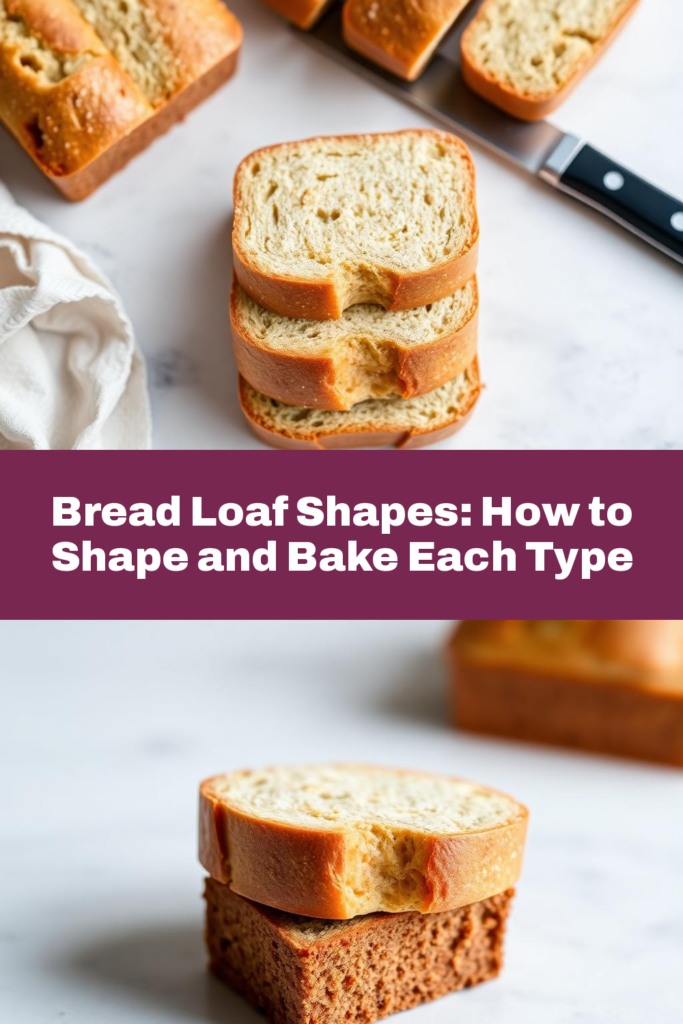
Shaping a bread loaf is mostly about creating surface tension so the dough rises up instead of spreading wide. The classic loaf pan shape, a free-form round boule, and a long baguette each need a different shaping method and a different bake. This page covers the three most common loaf shapes, how to shape each one, and how to bake them so the crust is even and the crumb is light.
What Each Bread Loaf Shape Needs
Loaf pan breads (sandwich loaves) are shaped by flattening the dough into a rectangle and rolling it up tightly, which creates layers that give an even crumb. Free-form rounds (boule) are shaped by pulling the dough into a ball and creating tension on the surface with a bench scraper. Baguettes are shaped by rolling the dough into a long cylinder and then rolling it back and forth to lengthen it. Each shape changes the crust-to-crumb ratio: a loaf pan gives soft sides, a boule gives a thick crust all around, and a baguette gives a crisp crust with a light, open crumb.
Ingredients for One Basic Bread Dough
This dough works for all three shapes. It makes one 9×5-inch (23×13 cm) loaf, one 9-inch (23 cm) round boule, or two 12-inch (30 cm) baguettes.
- 3 ½ cups (440 g) bread flour, plus more for dusting
- 1 ½ cups (360 ml) warm water (about 105°F / 40°C)
- 2 teaspoons (8 g) instant yeast
- 1 ½ teaspoons (9 g) fine salt
- 1 tablespoon (15 ml) olive oil, for the bowl
How to Shape a Loaf Pan Bread (Sandwich Loaf)
After the first rise, turn the dough onto a lightly floured surface. Gently press it into a rectangle about 8 inches wide and 10 inches long (20 x 25 cm), with the short side facing you. Fold the top third down to the center, then the bottom third up over it, like a letter. Pinch the seam closed. Roll the dough over so the seam is on the bottom. Place it seam-side down in a greased 9×5-inch (23×13 cm) loaf pan. Cover with oiled plastic wrap and let it rise until it is about 1 inch (2.5 cm) above the rim of the pan, about 45–60 minutes at room temperature.
Why the Roll-Up Matters
Rolling the dough into a tight cylinder creates layers that trap gas and give a fine, even crumb. If you just plop the dough in the pan, the loaf will be dense and lopsided.
How to Shape a Round Boule (Free-Form)
Turn the dough onto a lightly floured surface. Gently pull the edges of the dough toward the center, one at a time, to create a ball. Flip the dough seam-side down. Cup your hands around the dough and rotate it in a circular motion, pulling the dough toward you and tucking it underneath, to create a smooth, tight top. The surface should feel taut. Let it rest for 10 minutes, then repeat the cupping and rotating once more. Place the boule seam-side down on a parchment-lined baking sheet or in a floured proofing basket. Cover and let it rise until it is puffy and nearly doubled, about 60–75 minutes.
How to Tell the Boule Is Ready to Bake
Press a floured finger gently into the side of the dough. If the indentation springs back slowly and leaves a slight mark, it is ready. If it springs back immediately, let it rise 15 more minutes. If it does not spring back at all, it is over-proofed and will collapse in the oven.
How to Shape Baguettes
Divide the dough into two equal pieces. On a lightly floured surface, gently press each piece into a rough rectangle about 6 inches wide and 8 inches long (15 x 20 cm). Fold the top third down to the center, then the bottom third up over it. Pinch the seam closed. With the seam side down, use your palms to roll the dough back and forth, starting from the center and moving outward, until it is about 12 inches (30 cm) long. The ends should be slightly tapered. Place the baguettes seam-side down on a floured linen cloth or a parchment-lined baking sheet, cover, and let rise for 45–60 minutes, until puffy.
Why Baguettes Need a Hotter Oven
Baguettes bake at a higher temperature than loaf pan breads—500°F (260°C) with steam—to get a thin, crackly crust. The steam keeps the surface moist while the inside bakes, then the crust sets as the steam dissipates. If you do not have a steam setup, place a metal pan on the bottom oven rack and pour 1 cup (240 ml) of boiling water into it when you put the bread in.
Baking Temperatures and Times for Each Shape
Preheat the oven to the temperature listed for the shape you are making. Place a baking stone or a heavy baking sheet on the middle rack while the oven heats.
| Shape | Oven Temp | Bake Time | Doneness Cue |
|---|---|---|---|
| Loaf pan bread | 375°F (190°C) | 35–40 minutes | Internal temp 190–200°F (88–93°C); top is deep golden |
| Boule | 450°F (232°C) | 30–35 minutes | Internal temp 200–210°F (93–99°C); crust is dark brown |
| Baguette | 500°F (260°C) | 20–25 minutes | Internal temp 200–210°F (93–99°C); crust is deep golden and crisp |
For all shapes, check the internal temperature with an instant-read thermometer inserted through the bottom or side. The bread is done when it reaches the range above. If the top is browning too fast, tent it loosely with foil for the last 10 minutes.
Scoring the Dough Before Baking
Scoring controls where the bread expands in the oven. Use a sharp razor blade or a lame. For a loaf pan bread, make one long slash down the center, about ½ inch (1 cm) deep. For a boule, make one large X or a single arc across the top. For baguettes, make three or four diagonal slashes, each overlapping the previous one by about a third. Score just before putting the bread in the oven, when the dough is fully risen.
Cooling and Slicing the Bread
Cool the bread on a wire rack. A loaf pan bread needs 30 minutes in the pan, then remove it and cool completely before slicing, about 1 hour total. A boule and baguettes should be removed from the baking sheet immediately and cooled completely, about 45 minutes. Slicing warm bread compresses the crumb and makes it gummy. Use a serrated knife and a gentle sawing motion, not a pressing motion.
Make-Ahead and Storage for Shaped Loaves
You can shape the dough and refrigerate it overnight after the first rise. The cold slows the yeast, so the shaped loaves will need a longer second rise—about 2 hours at room temperature instead of 60–75 minutes. Bake straight from the fridge for a more complex flavor, adding 5–10 minutes to the bake time. Baked bread keeps at room temperature in a paper bag for 2–3 days; a plastic bag keeps it softer but softens the crust. Freeze baked loaves for up to 3 months, wrapped tightly in plastic wrap and then foil. Thaw at room temperature, then reheat in a 350°F (175°C) oven for 5–10 minutes to crisp the crust. Do not refrigerate bread—it goes stale faster at cold temperatures.
What to Do If the Loaf Spreads Sideways
If a free-form boule or baguette flattens out during baking, the dough was under-shaped or over-proofed. The surface tension was not tight enough, or the gluten relaxed too much. Next time, shape more firmly and check the proofing with the finger-poke test. For a loaf pan, spreading usually means the dough was too wet or the pan was too large. Use the exact flour amount and a 9×5-inch (23×13 cm) pan.
Substitutions and Variations for Shaped Bread
Use all-purpose flour instead of bread flour for a slightly less chewy crumb; the loaf will be a bit shorter. Whole wheat flour can replace up to half of the bread flour; add 2 tablespoons (30 ml) more water and expect a denser crumb. For an enriched loaf, add 2 tablespoons (28 g) butter and 1 large egg to the dough; this makes a softer, richer sandwich bread that browns faster. For a seeded crust, brush the shaped loaf with beaten egg and press seeds onto the surface before baking.
Serving and Pairing Ideas for Each Shape
Slice the loaf pan bread for sandwiches, toast, or French toast. The boule is best for tearing and dipping in olive oil or serving with soups and stews. Baguettes are for slicing into rounds for crostini, or serving alongside cheese and charcuterie. All three freeze well, so you can make one dough and bake different shapes on different days.
Safe minimum internal temperatures follow USDA FSIS; raw-fish guidance follows the U.S. FDA. See our food safety notes.
Spotted an error? Tell us and we will correct it (corrections policy).