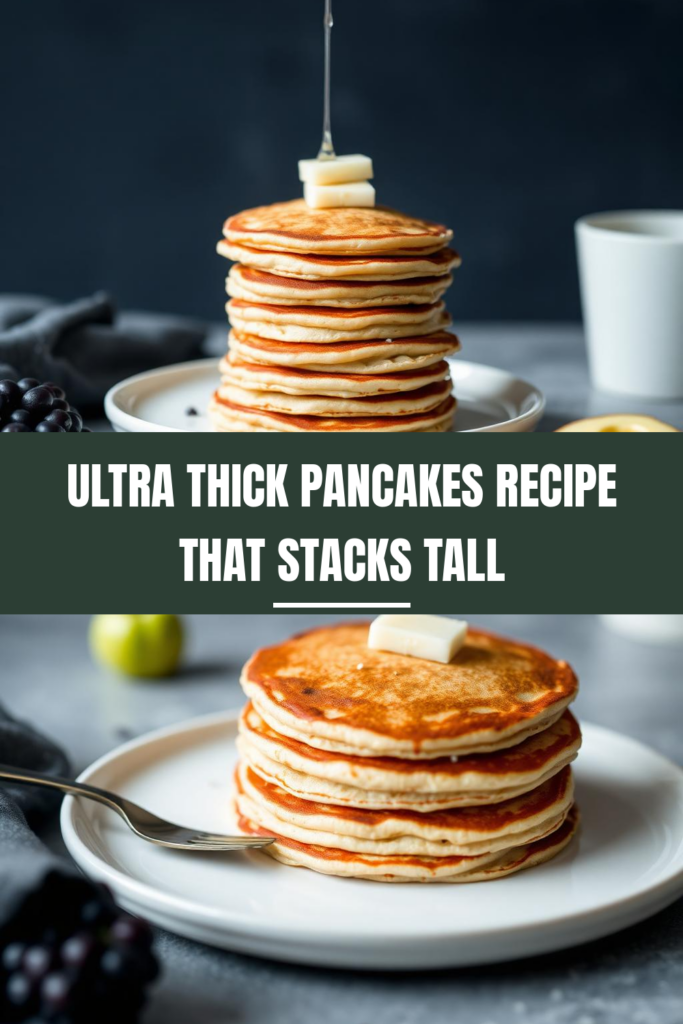
Ultra thick pancakes are dense, fluffy, and about 1 inch (2.5 cm) tall, made by using a thick batter with extra baking powder and a gentle cooking method. They need a low heat and a lid to cook through without burning the outside. This recipe gives you a stack that holds its height and stays tender inside.
What Equipment Matters for Thick Pancakes
Use a heavy-bottomed skillet or griddle, preferably cast iron or nonstick, at least 10 inches (25 cm) wide. A lid that fits the pan is essential—it traps steam and cooks the center of the thick pancake. A thin metal spatula works best for flipping. A 1/4-cup (60 ml) measuring cup or a ladle helps you portion the batter evenly. A food thermometer is not needed for pancakes, but a timer is useful.
Ingredients
- 2 cups (250 g) all-purpose flour
- 3 tbsp (36 g) granulated sugar
- 1 tbsp (12 g) baking powder
- 1/2 tsp (3 g) baking soda
- 1/2 tsp (3 g) salt
- 1 1/2 cups (360 ml) buttermilk, at room temperature
- 1/2 cup (120 ml) whole milk, at room temperature
- 2 large eggs, at room temperature
- 3 tbsp (42 g) unsalted butter, melted and cooled
- 1 tsp (5 ml) vanilla extract
- Butter or neutral oil for the pan
If you don’t have buttermilk, use 1 1/2 cups (360 ml) whole milk plus 1 1/2 tbsp (22 ml) lemon juice or white vinegar; let it sit for 5 minutes. The acid reacts with the baking soda, giving the same lift. Using only milk without acid will make the pancakes flatter and less tender.
How to Make Ultra Thick Pancakes
- In a large bowl, whisk together the flour, sugar, baking powder, baking soda, and salt. Make a well in the center.
- In a separate bowl or large measuring cup, whisk the buttermilk, milk, eggs, melted butter, and vanilla until combined.
- Pour the wet ingredients into the dry ingredients. Stir with a spatula or wooden spoon until just combined—the batter should be lumpy and thick, with no dry streaks. Do not overmix; overmixing develops gluten and makes the pancakes tough. Let the batter rest for 5 minutes while the pan heats.
- Place the skillet over medium-low heat (about 300°F/150°C if your burner has a setting). Add a small pat of butter or a teaspoon of oil and spread it around. When the butter foams but does not brown, the pan is ready.
- Pour 1/4 cup (60 ml) of batter per pancake onto the skillet. Do not spread it; let it form a thick circle. For larger pancakes, use 1/3 cup (80 ml) and expect a longer cook time. You should fit 2–3 pancakes in a 10-inch (25 cm) pan, leaving space between them.
- Cover the pan with the lid. Cook for 2–3 minutes, until bubbles appear on the surface and the edges look set. The bottom should be golden brown—check by lifting a corner with the spatula.
- Flip the pancakes carefully with a thin spatula. Cover again and cook for another 2–3 minutes, until the second side is golden brown and the center springs back when pressed gently. The pancakes should be about 1 inch (2.5 cm) thick and cooked through. If the outside browns too fast, lower the heat to low (250°F/120°C) and increase the cook time slightly.
- Transfer the pancakes to a plate and keep them warm in a 200°F (95°C) oven while you cook the remaining batter. Repeat with the remaining batter, adding more butter or oil to the pan as needed.
The total cook time for one batch of 8–10 pancakes is about 20–25 minutes. The resting time is 5 minutes, and the total time from mixing to the last pancake is about 30–35 minutes.
How Many Pancakes Does This Make?
This recipe makes 8–10 pancakes, each about 4 inches (10 cm) across and 1 inch (2.5 cm) thick. For a family of four, that’s 2–3 pancakes per person. If you need more, use the table below to scale the ingredients. The cooking time stays the same per batch, but you’ll need to cook in batches, so total time increases by about 5 minutes per extra batch.
| Servings | Flour | Buttermilk | Milk | Eggs | Baking Powder |
|---|---|---|---|---|---|
| 2 (4–5 pancakes) | 1 cup (125 g) | 3/4 cup (180 ml) | 1/4 cup (60 ml) | 1 | 1 1/2 tsp (6 g) |
| 4 (8–10 pancakes) | 2 cups (250 g) | 1 1/2 cups (360 ml) | 1/2 cup (120 ml) | 2 | 1 tbsp (12 g) |
| 6 (12–15 pancakes) | 3 cups (375 g) | 2 1/4 cups (540 ml) | 3/4 cup (180 ml) | 3 | 1 1/2 tbsp (18 g) |
| 8 (16–20 pancakes) | 4 cups (500 g) | 3 cups (720 ml) | 1 cup (240 ml) | 4 | 2 tbsp (24 g) |
For other ingredients (sugar, salt, baking soda, butter, vanilla), scale proportionally: for 3 cups flour use 4 1/2 tbsp sugar, 3/4 tsp salt, 3/4 tsp baking soda, 4 1/2 tbsp butter, and 1 1/2 tsp vanilla.
What Goes Wrong and How to Fix It
Pancakes are burnt outside but raw inside
This happens when the heat is too high. The outside browns before the center cooks. Use medium-low heat and cover the pan to trap steam. If the first pancake is too dark, lower the heat and wait for the pan to cool slightly before the next batch.
Pancakes are flat and thin
The batter was overmixed, or the baking powder was old. Overmixing deflates the air and develops gluten, making the pancakes tough and flat. Stir only until combined. Check your baking powder’s freshness by mixing 1 tsp (5 g) with 1/3 cup (80 ml) hot water—it should bubble vigorously. If not, replace it.
Pancakes stick to the pan
The pan wasn’t hot enough or wasn’t greased enough. Use a pat of butter or oil before each batch. Make sure the pan is heated to medium-low before adding the batter. If using a nonstick pan, avoid using metal utensils that can scratch the surface.
How to Serve and Store Ultra Thick Pancakes
Serve the pancakes warm with butter and maple syrup, or top with fresh berries, sliced bananas, or a spoonful of whipped cream. They also work well with savory toppings like fried eggs and bacon. Because they are thick, they hold up to heavy toppings without getting soggy.
Leftover pancakes keep in the refrigerator for up to 3 days in an airtight container. To reheat, place them in a toaster or a 350°F (175°C) oven for 5–7 minutes, until warmed through. You can also freeze them for up to 2 months: lay them in a single layer on a baking sheet, freeze until solid, then transfer to a zip-top bag. Reheat frozen pancakes directly in the toaster or oven.
If you’re making them ahead for a crowd, keep cooked pancakes warm in a 200°F (95°C) oven for up to 30 minutes, but they will dry out if held longer. For best texture, serve within 15 minutes of cooking.
Can I Make the Batter Ahead?
You can mix the dry ingredients and wet ingredients separately up to 1 day ahead and store them covered in the refrigerator. Combine them just before cooking. The batter itself should not be made ahead—the leavening starts working immediately, and the batter will lose its lift within 30 minutes. If you must rest the batter, keep it in the fridge for no more than 15 minutes, but expect slightly flatter pancakes.
Safe minimum internal temperatures follow USDA FSIS; raw-fish guidance follows the U.S. FDA. See our food safety notes.
Spotted an error? Tell us and we will correct it (corrections policy).