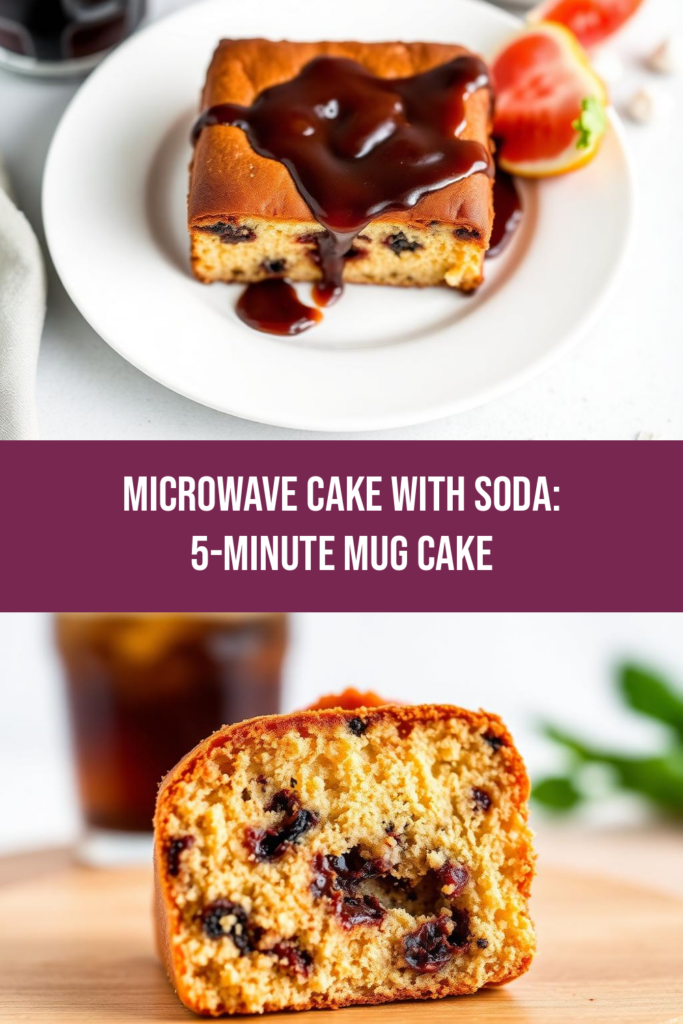
Time: 5 minutes total · Serves: 1 · The key step: mix the soda into the batter last, then microwave in 30-second bursts until the top springs back. A single-serving cake made from pantry staples and any carbonated soda, ready in about 5 minutes.
Ingredients for One Mug Cake
- 4 tablespoons (30 g) all-purpose flour
- 3 tablespoons (35 g) granulated sugar
- 1/4 teaspoon baking powder
- 1/8 teaspoon salt
- 3 tablespoons (45 ml) soda (cola, lemon-lime, root beer, or any flavor)
- 1 tablespoon (15 ml) vegetable oil or melted butter
- 1/4 teaspoon vanilla extract (optional)
Use a 12-ounce (350 ml) microwave-safe mug. The batter will rise and may overflow if the mug is smaller.
Instructions: Mix, Microwave, and Check Doneness
- In the mug, whisk together the flour, sugar, baking powder, and salt.
- Add the soda, oil, and vanilla. Stir until just combined; a few lumps are fine.
- Microwave on high for 60 seconds. Check the top: it should look set and spring back when lightly pressed. If still wet, microwave in 15-second bursts, checking each time, up to 90 seconds total. Cooking time varies by microwave wattage (most home microwaves are 700–1100 W).
- Let cool for 1 minute before eating. The cake will be very hot inside.
Why the Cake Can Turn Out Dry, Runny, or Dense
Dry and Rubbery
Cause: Overcooking. The microwave keeps cooking even after it stops, so a cake that looks done at 60 seconds may dry out by 75 seconds. Fix: Stop as soon as the top is set and springs back. If your microwave is powerful (above 1000 W), start with 45 seconds.
Runny in the Center
Cause: Not enough time, or the batter was too wet. Soda adds liquid and carbonation; too much soda makes a thin batter that needs longer. Fix: Cook in 15-second bursts until the center is no longer glossy. If the center still looks wet after 90 seconds, the batter may have been too thin—next time reduce the soda to 2 1/2 tablespoons (37 ml).
Dense and Gummy
Cause: Overmixing. Stirring too much develops gluten, making the cake tough. Fix: Stir only until the flour disappears. Also check that the baking powder is fresh (replace after 6 months).
Scaling for Two or Four Servings
Multiply the ingredients by the factor below and use a larger microwave-safe dish. Increase cooking time by about 30 seconds per extra serving, checking in 15-second bursts.
| Servings | Flour | Sugar | Baking powder | Soda | Oil | Microwave time (approx.) |
|---|---|---|---|---|---|---|
| 1 | 4 tbsp (30 g) | 3 tbsp (35 g) | 1/4 tsp | 3 tbsp (45 ml) | 1 tbsp (15 ml) | 60–75 sec |
| 2 | 1/2 cup (60 g) | 6 tbsp (70 g) | 1/2 tsp | 6 tbsp (90 ml) | 2 tbsp (30 ml) | 90–120 sec |
| 4 | 1 cup (120 g) | 3/4 cup (140 g) | 1 tsp | 3/4 cup (180 ml) | 1/4 cup (60 ml) | 2–3 min |
For 2 servings, use a 4-cup (1 L) glass measuring cup. For 4, use a 2-quart (2 L) microwave-safe bowl. Stir halfway through for even cooking.
How to Store and Reheat Mug Cake
Mug cake is best eaten immediately. If you have leftovers, let it cool completely, wrap tightly in plastic wrap, and refrigerate for up to 2 days. To reheat, microwave on high for 15–20 seconds until warm. Do not freeze—the texture becomes rubbery.
Which Soda Works Best and How It Changes the Cake
Any carbonated soda works. Cola adds a caramel-like sweetness and dark color; lemon-lime gives a neutral, slightly citrus flavor; root beer adds a spicy note. Diet soda works but the cake may be slightly less tender because sugar adds moisture. For a chocolate version, replace 1 tablespoon (8 g) of flour with unsweetened cocoa powder. The soda’s carbonation helps the cake rise without eggs, so the cake is naturally egg-free.
Can I Make It Without Oil or Butter?
Yes. Replace the oil with 1 tablespoon (15 g) applesauce or mashed banana. The cake will be a bit denser and more moist, and the banana will add flavor. If using applesauce, reduce the soda to 2 1/2 tablespoons (37 ml) to keep the batter from getting too thin.
Why the Cake Sometimes Overflows the Mug
The carbonation in soda creates bubbles that expand in the microwave. To prevent overflow, use a mug that is at least twice the volume of the batter (a 12-ounce mug works). If it still rises too high, reduce the soda by 1/2 tablespoon (7 ml) and add 1/2 tablespoon (7 ml) water. Also, do not fill the mug more than halfway with batter.
Safe minimum internal temperatures follow USDA FSIS; raw-fish guidance follows the U.S. FDA. See our food safety notes.
Spotted an error? Tell us and we will correct it (corrections policy).





