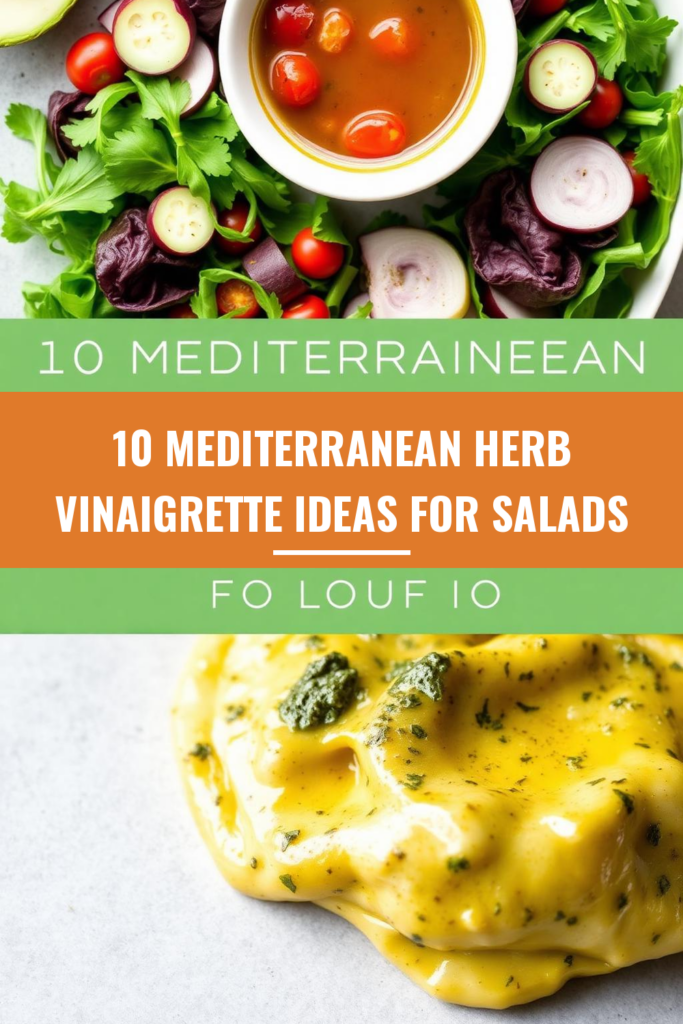
Here are 10 Mediterranean herb vinaigrette ideas, each a quick whisk-and-pour dressing that suits salads, grilled vegetables, or roasted chicken. They all use olive oil, vinegar or lemon, and fresh or dried herbs, and most take under 5 minutes to mix.
What Each Vinaigrette Is and When to Use It
1. Classic Oregano-Lemon Vinaigrette
Bright and sharp, this is the standard for Greek salads and grilled lamb. Use dried oregano for a stronger flavor.
- 1/4 cup (60 ml) fresh lemon juice
- 1/2 cup (120 ml) extra-virgin olive oil
- 1 tbsp (15 ml) red wine vinegar
- 1 tsp dried oregano
- 1 small garlic clove, minced
- 1/2 tsp salt, 1/4 tsp black pepper
- Whisk lemon juice, vinegar, oregano, garlic, salt, and pepper in a bowl.
- Slowly drizzle in olive oil while whisking until emulsified.
- Let sit 5 minutes before using. Store in a jar up to 1 week.
Makes about 3/4 cup (180 ml) · Total 5 min
2. Basil-Pine Nut Vinaigrette
Nutty and herbaceous, this suits tomato salads, mozzarella, or pasta salad. Toast the pine nuts for more depth.
- 1 cup (20 g) fresh basil leaves, packed
- 2 tbsp (15 g) pine nuts, toasted
- 1/4 cup (60 ml) white wine vinegar
- 1/2 cup (120 ml) olive oil
- 1/2 tsp salt, 1/4 tsp black pepper
- Blend basil, pine nuts, vinegar, salt, and pepper in a blender until smooth.
- With motor running, add olive oil in a slow stream.
- Taste and add more salt if needed. Use within 2 days; basil darkens.
Makes about 1 cup (240 ml) · Total 5 min
3. Mint-Yogurt Vinaigrette
Creamy and cooling, for fattoush, cucumber salad, or grilled chicken. The yogurt replaces some oil, so it’s lighter.
- 1/2 cup (120 g) plain Greek yogurt
- 1/4 cup (60 ml) fresh lemon juice
- 1/4 cup (60 ml) olive oil
- 1/4 cup (10 g) fresh mint leaves, chopped
- 1 small garlic clove, minced
- 1/2 tsp salt
- Whisk yogurt, lemon juice, garlic, and salt until smooth.
- Whisk in olive oil and mint. Add 1–2 tbsp water if too thick.
- Refrigerate up to 3 days; stir before using.
Makes about 1 cup (240 ml) · Total 5 min
4. Rosemary-Balsamic Vinaigrette
Earthy and slightly sweet, for roasted vegetables, grilled steak, or arugula salad. Use fresh rosemary for best flavor.
- 1/4 cup (60 ml) balsamic vinegar
- 1 tbsp (15 ml) Dijon mustard
- 1 tsp fresh rosemary, finely chopped
- 1/2 cup (120 ml) olive oil
- 1/2 tsp salt, 1/4 tsp black pepper
- Whisk vinegar, mustard, rosemary, salt, and pepper.
- Drizzle in olive oil while whisking.
- Let stand 10 minutes for rosemary to infuse. Store up to 1 week.
Makes about 3/4 cup (180 ml) · Total 5 min
5. Cilantro-Lime Vinaigrette
Fresh and zesty, for black bean salads, grilled fish, or taco bowls. Use cilantro stems—they have flavor.
- 1/2 cup (15 g) fresh cilantro, packed
- 1/4 cup (60 ml) fresh lime juice
- 1 tsp honey
- 1/2 cup (120 ml) olive oil
- 1/2 tsp ground cumin
- 1/2 tsp salt
- Blend cilantro, lime juice, honey, cumin, and salt until smooth.
- Add olive oil and blend 10 seconds more.
- Use within 2 days; shake before using.
Makes about 1 cup (240 ml) · Total 5 min
6. Dill-Mustard Vinaigrette
Tangy and herb-forward, for cucumber salads, potato salad, or smoked salmon. Dill pairs well with lemon.
- 1/4 cup (60 ml) white wine vinegar
- 2 tbsp (30 g) Dijon mustard
- 1 tbsp (15 ml) honey
- 1/4 cup (10 g) fresh dill, chopped
- 1/2 cup (120 ml) olive oil
- 1/2 tsp salt
- Whisk vinegar, mustard, honey, dill, and salt.
- Slowly whisk in olive oil until creamy.
- Refrigerate up to 1 week; bring to room temperature before use.
Makes about 3/4 cup (180 ml) · Total 5 min
7. Tarragon-Champagne Vinaigrette
Delicate and slightly anise-like, for green salads, chicken salad, or steamed asparagus. Champagne vinegar is mild.
- 1/4 cup (60 ml) champagne vinegar
- 1 tsp Dijon mustard
- 1 tbsp fresh tarragon, chopped
- 1/2 cup (120 ml) olive oil
- 1/4 tsp salt, 1/8 tsp black pepper
- Whisk vinegar, mustard, tarragon, salt, and pepper.
- Drizzle in olive oil while whisking.
- Use within 3 days; tarragon loses flavor quickly.
Makes about 3/4 cup (180 ml) · Total 5 min
8. Thyme-Sherry Vinaigrette
Savory and nutty, for lentil salads, roasted beets, or grilled mushrooms. Sherry vinegar is less acidic than red wine.
- 1/4 cup (60 ml) sherry vinegar
- 1 tsp fresh thyme leaves
- 1 small shallot, minced (about 1 tbsp)
- 1/2 cup (120 ml) olive oil
- 1/2 tsp salt, 1/4 tsp black pepper
- Whisk vinegar, thyme, shallot, salt, and pepper.
- Whisk in olive oil slowly.
- Let sit 10 minutes before using. Store up to 1 week.
Makes about 3/4 cup (180 ml) · Total 5 min
9. Parsley-Garlic Vinaigrette
Pungent and green, for grain bowls, roasted chicken, or grilled vegetables. Flat-leaf parsley works best.
- 1 cup (30 g) fresh flat-leaf parsley, packed
- 2 garlic cloves, roughly chopped
- 1/4 cup (60 ml) red wine vinegar
- 1/2 cup (120 ml) olive oil
- 1/2 tsp salt, 1/4 tsp red pepper flakes (optional)
- Blend parsley, garlic, vinegar, salt, and pepper flakes until minced.
- Add olive oil and blend until smooth.
- Use within 2 days; garlic intensifies.
Makes about 1 cup (240 ml) · Total 5 min
10. Mixed Herb Vinaigrette (Oregano, Basil, Thyme)
A versatile all-purpose dressing for any salad or as a marinade. Use dried herbs if fresh are unavailable—use half the amount.
- 1/4 cup (60 ml) red wine vinegar
- 1 tsp dried oregano
- 1 tsp dried basil
- 1/2 tsp dried thyme
- 1 small garlic clove, minced
- 1/2 cup (120 ml) olive oil
- 1/2 tsp salt, 1/4 tsp black pepper
- Whisk vinegar, dried herbs, garlic, salt, and pepper.
- Slowly whisk in olive oil.
- Let sit 15 minutes to rehydrate herbs. Store up to 2 weeks.
Makes about 3/4 cup (180 ml) · Total 5 min
Quick Comparison of the 10 Vinaigrettes
| # | Name | Best For | Flavor Profile | Shelf Life |
|---|---|---|---|---|
| 1 | Oregano-Lemon | Greek salad, grilled lamb | Sharp, herbal | 1 week |
| 2 | Basil-Pine Nut | Tomato, mozzarella | Nutty, sweet | 2 days |
| 3 | Mint-Yogurt | Fattoush, cucumber | Cool, creamy | 3 days |
| 4 | Rosemary-Balsamic | Roasted veg, steak | Earthy, sweet | 1 week |
| 5 | Cilantro-Lime | Black bean, fish | Fresh, citrusy | 2 days |
| 6 | Dill-Mustard | Potato salad, salmon | Tangy, herbal | 1 week |
| 7 | Tarragon-Champagne | Green salad, chicken | Delicate, anise | 3 days |
| 8 | Thyme-Sherry | Lentil, beets | Savory, nutty | 1 week |
| 9 | Parsley-Garlic | Grain bowls, chicken | Pungent, green | 2 days |
| 10 | Mixed Herb | Any salad, marinade | Balanced, herbal | 2 weeks |
What Goes Wrong When Choosing a Vinaigrette
Using dried herbs when fresh is called for. Dried herbs are more concentrated; if a recipe calls for fresh and you use dried, reduce to one-third. Conversely, fresh herbs in place of dried need triple the amount. For example, 1 tsp dried oregano = 1 tbsp fresh oregano.
Emulsifying too late. If you add oil all at once, the dressing separates. Always whisk or blend the acid, herbs, and seasonings first, then add oil in a slow, steady stream while whisking. A blender or jar with a tight lid works too.
Overpowering with garlic. Raw garlic gets stronger as it sits. If making ahead, reduce garlic by half or use a pinch of garlic powder instead. Taste after 30 minutes and adjust.
How Long Do These Vinaigrettes Keep?
Most vinaigrettes with fresh herbs last 2–3 days in the refrigerator; those with dried herbs last up to 2 weeks. Always store in an airtight jar or bottle. Olive oil will solidify when cold—let it sit at room temperature for 15 minutes and shake before using. Discard if you see mold or an off smell.
How to Make a Vinaigrette Ahead for a Party
Make any of these up to 3 days ahead, but add fresh herbs just before serving to keep their color and flavor. For a large batch, double or triple the recipe and blend in a food processor. Keep the dressing refrigerated and bring to room temperature before tossing with salad—cold dressing wilts greens.
Vinaigrette for Grilled Meats and Vegetables
Use any of these as a marinade for chicken, beef, or vegetables. For food safety, marinate in the refrigerator, not on the counter. Discard any leftover marinade that touched raw meat. Cook poultry to 165°F (74°C), ground meat to 160°F (71°C), and whole cuts to 145°F (63°C) with a 3-minute rest, per USDA FSIS. If using as a finishing sauce, set aside a separate portion before adding raw meat.
Safe minimum internal temperatures follow USDA FSIS; raw-fish guidance follows the U.S. FDA. See our food safety notes.
Spotted an error? Tell us and we will correct it (corrections policy).